Friday, May 26, 2023

A Visit with Parks Canada (Part 3 of 3)

Charles Dagneau opening a drawer of relics for myself and Mary Williamson 
Of course, throughout the tour all of us felt immensely excited to learn more about the vital work being done on the Franklin relics, but we couldn't help ourselves if the most exciting prospect of all was to see conserved relics that we could actually examine, and even hold in our (gloved) hands! Our guide for this portion of the tour was Parks archaeologist Charles Dagneau, whom most of us had first met back at the Death in the Ice opening in Ottawa in March of 2018. Now, five years later, we had the immense good fortune to visit the twin vaults that store conserved artifacts -- Franklin's amongst many others -- and really see them up close.

Fragment of the wheel of HMS Erebus
There are two vaults, as it happens -- one in which the humidity is kept higher, so as to prevent any further drying-out of organic (wood, leather, ropeage, etc.) artifacts -- and one in which the humidity is kept low, so as to minimize the chance of rust or corrosion on metal objects. We visited the high-humidity room first, where we saw the wheel of the Breadalbane (see last post) as well as the section of the wheel of HMS Erebus. It was a remarkable feeling to grasp -- again, with gloved hands -- the wheel that Franklin and his helmsmen had grasped when steering their ship amidst the Arctic ice! Also in this room we saw ceramic objects -- indifferent to moisture as they are -- including several of the transferware and other plates and serving vessels so far recovered. Charles explained to us the how the quality of the China gave an indication of those who dined upon it: the Blue Willow plates would have been used by the crew in the forecastle, while the Whampoa ones were likely from Franklin's own table in the great cabin, or else the officers' mess.

We then went to the room of metal objects, which I'd been particularly curious to see. Among the stars there was the still-unidentified "scientific instrument," which is visible in the photo at top -- it was far smaller than I'd pictured it, and more delicate; clearly it had been made with care and precision, but for what purpose we don't yet know. 

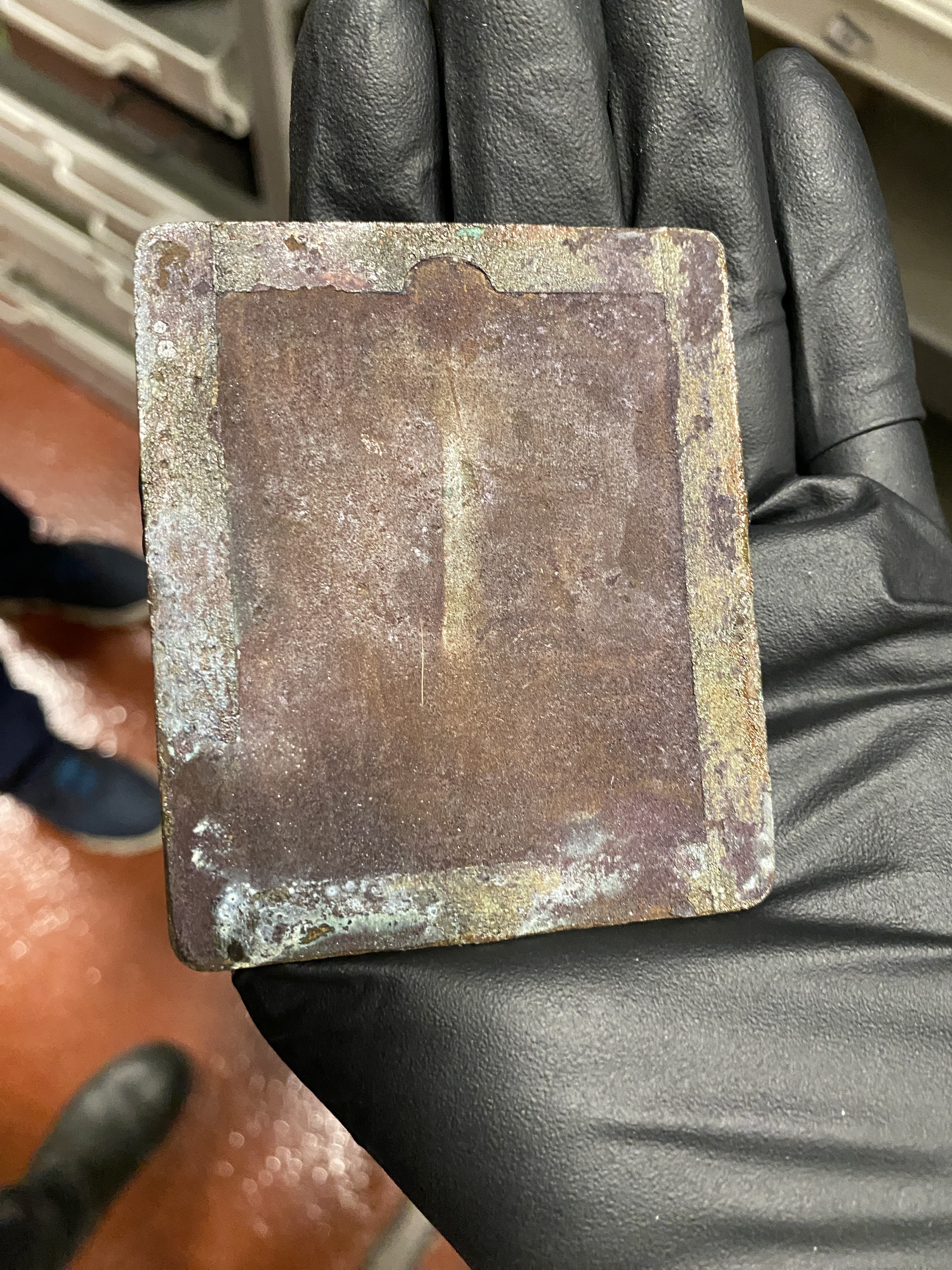
The heavy metal object
Nearby, I spotted a smaller, heavier metal object -- it had a handle shaped rather like one might see on a large rubber stamper, but was all solid brass; the underside disclosed a flat surface, within which was a smaller rectangle with a small half-moon cutaway on one side. I was struck at once by the fact that the square seemed similar in proportion to the Franklin daguerreotypes made by the operator from Richard Beard's firm. I knew that, as part of the Daguerreotype process, the silver-covered copper plates had to be carefully polished to a mirror-like finish, and it struck me that the object might have been used for such polishing.

After our tour, I had to head back home to Rhode Island -- I'd driven to Ottawa -- and didn't get back until quite late. The next day, looking at the image of that metal object, I decided I'd send it to Bill Schultz, a friend and collector whose article on the Franklin Daguerreotypes is a standard reference in the field. He was quite excited, and agreed with my inference; he in turn sent the photos to Mike Robinson, the president of the Daguerreian Society and one of the world's top experts on the historical process.

Johnson's Patent
Mike at once recognized it as part of a plate-polishing apparatus patented by John Johnson in 1841; the identification was made all the more certain because Johnson himself was a business associate of Richard Beard! If, as described in the Illustrated London News, the Beard apparatus used to take the officers' portraits in 1845 was the same as was stowed aboard ship, it would make perfect sense that it would have included Johnson's device. However, on checking the object's measurements, Peter Carney realized that it corresponded with the smaller, ninth-plate format (the Franklin portraits were sixth-plates); based on this, Mike said it's more likely that a different camera, a Wolcott model which used a tin mirror in the place of a lens, was the one Beard supplied to the expedition (Wolcott was also a business partner of Johnson, and his camera is sometimes called the Wolcott-Johnson camera).

So now we have something we didn't have before: clear evidence that indeed such an apparatus was aboard HMS "Erebus," and that, assuming it was used as intended, Daguerreotypes were almost certainly made during the expedition. It's only one small step to add to the hope that someday such plates may be recovered; if they are, they'll be the earliest photographs ever taken in the Arctic!

In conclusion, I'd like to extend our warm and collective thanks to Jonathan Moore, Charles Dagneau, Cindy Lee Scott, and everyone else we met for their tremendous generosity in giving us a glimpse of the less-visible -- but extraordinarily important -- work they do in these labs.

Wednesday, May 24, 2023

A Visit with Parks Canada (part 2 of 3)

Charles Dagneau, Cindy Lee Scott, and Jonathan Moore
Our tour now commenced in earnest. One of the first staff members we met was Cindy Lee Scott, who among her other responsibilities is in charge of the making of replicas of artifacts for display. She was particularly excited to show us her new and larger 3D printer, along with a series of preliminary versions of the replica of the sword hilt found aboard HMS "Erebus." Through looking at these alongside one another, we could see how corrections were made, including those of precise scale, before the final version for the Death in the Ice was produced. Later on, we were able to see the original hilt; it was remarkable to see how every exact detail had been matched.

Trial hilts
Cindy Lee then continued guiding our tour, taking us to other departments such as the reproduction lab, the paper lab, and finally the objects lab. There, we saw numerous artifacts still undergoing various processes to stabilize their materials. In a large tank, we saw the recovered cannon, now down to its final few baths, its surface looking as smooth and sharp as it must have when it was mounted aboard ship. Later, we saw the three cannonballs that were found inside its bore; they'd been difficult to extract, explained Parks archaeologist Charles Dagneau, and had to eventually be mechanically "scooped" out. Cindy Lee's enthusiasm for her work, and the excitement she and other staff based at the lab felt about the process of conserving the recovered items from the ship, came through loud and clear.

Near these tanks, we also saw a freeze-dryer, in which paper, wood, and certain other organic items were being treated. Here, the goal is to extract all moisture, something which sometimes follows, and sometimes precedes, other treatment. Wood, of course, can pose a special challenge, as when it dries it also loses a good portion of some of its internal material; this then has to be replaced with polyethylene glycol (known as PEG in the trade). Many will recall the wreck of the Mary Rose, which after being brought to the surface and reconstructed, had to constantly be sprayed with cold water to prevent this loss, and thereafter with PEG to replace the lost water so that each element would maintain its structural strength. The process is similar with much smaller wooden items.

The wheel of Breadalbane
Each type of wood or metal may have varying requirements, and artifacts with more than one type pose a special challenge. One of the most challenging ever was the ship's wheel of the Breadalbane, a supply ship and part of a Franklin search convoy, which sank off Beechey Island in 1853. It was removed by the ever-intrepid Joe MacInnis, who had discovered the wreck in 1980 -- against the strong advice of archaeologists -- and spent many many years in conservation due to its several types of wood and different metals. It rests now in a custom-made case in Parks's conservation facility, a testimony both to the Franklin search and the care and persistence of conservators.

In my next installment, I'll be taking my readers into that same vault where the wheel is stored -- specifically to those shelves on which those Franklin artifacts that have made it through the conservation process are stored!

Tuesday, May 23, 2023

A Visit with Parks Canada (part 1 of 3)

In a city filled with government buildings, this one doesn't stand out all that much, not from outside. Among other things, it contains a laboratory where children's toys are tested for their safety. But to me -- along with my colleagues Peter Carney and Mary Williamson -- this building stands alone, as it houses the most fascinating collection of materials in our world -- the artifacts brought up from HMS "Erebus" in the Canadian Arctic -- as well as the remarkable team of talented professionals who work with them, from the moment of their recovery to when -- sometimes months or even years later -- they have been fully conserved and stabilized, and may be stored or exhibited safely to generations to come.

Our host for our visit was Jonathan Moore, a veteran member of Parks's Underwater Archaeology Team (UAT) who last year became the the team's manager (many will recall his precursor, Marc-André Bernier, who recently retired). Jon helped us get cleared and signed in, then guided us down seemingly endless corridors with automatically-opening doors, reminiscent (as he noted) of the opening sequence of the 60's spy spoof Get Smart!

Behind the last set of these doors, we settled in for an introductory briefing in the team's work room, which includes a large bank of drawers for horizontal storage, a couple of glass cases with resin replicas of artifacts (Franklin's and others), and a table  featuring a meticulous model of the wreck of "Erebus," with a model Parks underwater archaeologist suspended near the as-yet-unretrieved ship's bell. Here we got a preview of the day's tour, which would include meeting many of the other staff members who check in, establish conservation plans, and keep track of, a wide and growing array of artifacts that range in size from a toothpick to a cannon.

When a new artifact arrives, having been stabilized sufficiently for transport, it's assessed in terms of what its conservation protocols should be. Metal articles, for instance, may require an extended soak in various solutions in order to help remove accretions, stabilize the metal's surface, and protect it against the eventual exposure to air. Wooden or paper items, in contrast, need mainly to be dried, but it's a process that requires extraordinary care. With wood, one later step requires a special polymer which, once absorbed by the wood, will fill the cavities between its fibers and give it sufficient strength to hold together. Paper is its own special case, especially if it appears to consist of multiple sheets, which require careful timing and great care to separate as the process finishes. For those reasons, the book or "portfolio" recovered during the 2022 dive season was unavailable for us to see.

And so, after our introductory briefing, we set out for our tour of the premises. First, we'd see the work area where the UAT's suits, helmets, and equipment are stored; then the area where replicas of the artifacts are carefully prepared; after that, a visit with the book and paper conservator, and the artist whose careful sketches help record each object and the location where it has been found. Lastly, of course, that area of the building which we were keenest to see -- the rooms where conserved relics are stored. Over the next few days, I'll be sharing the highlights of our visit, concluding with those much anticipated rooms -- it's my hope that my readers will get the sense of sharing in our excitement. So stay tuned!

Monday, December 19, 2022

Potential written material found on HMS Erebus

Image from Parks Canada
 It could be the breakthrough we've all been waiting for since the rediscovery of Franklin's ships -- or it could be just a small and tantalizing addition to what we know. In news covered around the world yesterday, we learned of what Ryan Harris, veteran member of the Parks Canada Underwater Archaeology Team (and the first person to see the shadow of "Erebus" on a sonar screen in 2014), called "the most remarkable find of the summer": a leatherbound folio, containing leaves of paper and a quill pen tucked inside its cover, found in the area of the steward's pantry of HMS Erebus.

The dream of finding additional written materials goes back at least to the 1870's, when Jane Franklin asked Sir Allen Young to return to the Arctic in hopes of finding some; she died before he returned, and his expedition found no new papers. The cry of "papers" once again became the motivating factor for Schwatka's search of 1878-80, and while they made some remarkable finds of human remains and other artifacts, the only sheet of paper they recovered turned out to be -- symbolically enough -- a blank one.

We don't know yet whether this new find bears any legible writing -- it's apparently still in the laboratory where paper conservators are patiently working on it -- and of course, even if it did, there's no telling how informative it might be. Other items found earlier in this area were associated with Edmund Hoar, Sir John Franklin's personal steward, and among these a pencil case was prominent. Might the newfound folio be a sketchbook? Then again, why the quill? The best case scenario might be that it might contain both writing and sketches, and we know of at least one other such journal, that kept by Captain's Steward John Messum aboard HMS "Vesuvius" during the Crimean War (1854-55). 

On the other hand, it might contain what might seem to be relatively trivial matter, perhaps some record-keeping of the contents of the Steward's pantry, or -- like the inscrutable "Peglar" papers, a mixture of doggerel verse and cryptic writings. From my own personal perspective, though, even if such a document were most mundane in its entries, each such entry would have one incredibly precious detail: a date. Right now, the lack of any post-1848 timeline is probably the singular most glaring gap in all we know about what Franklin's men did after the desertion of the ships. Were they re-manned? A simple date would tell us so. Abandoned again? When? And, like enormous goalposts, even a tiny handful of such dates would enable use to organize all kinds of other data with much higher accuracy; we would at last begin to know the "lay of the land" (and the water).

And yet, even if it has no information later than the desertion of the vessel, any kind of journal would be a goldmine, the more so if it were Hoar's own. As Franklin's steward, Hoar would have attended him daily, the more so during whatever illness or injury led to his death on June 11th 1847. Indeed, although Jane Franklin described the volume as a "quarto" rather than a folio, this could even be Sir John's long-lost private diary. It certainly fires the imagination!

Every so often, we come upon a document that literally rewrites history -- this newfound folio could well be just such a one -- only time and patient work on its pages will tell.

Friday, November 25, 2022

A Season of Marvels

L to R: Peter Carney, Mary Williamson, Russell Potter and Regina Koellner
For myself and my fellow editors of May We Be Spared to Meet on Earth, it has been a season of marvels, one for which all of us are enormously grateful. Although not all of us were able to be present at every event, we collectively felt and experienced a tremendous outpouring of interest in and support for our book.

It all began in Ottawa on September 26th, with our launch at 50 Sussex Drive at the headquarters of the Royal Canadian Geographical Society. It was a special pleasure here to share the event with Matthew Betts and his extraordinary book on HMS Terror; the audience's interest naturally extended to both volumes, as did their thoughtful, well-informed questions.

Hooks and Crookes
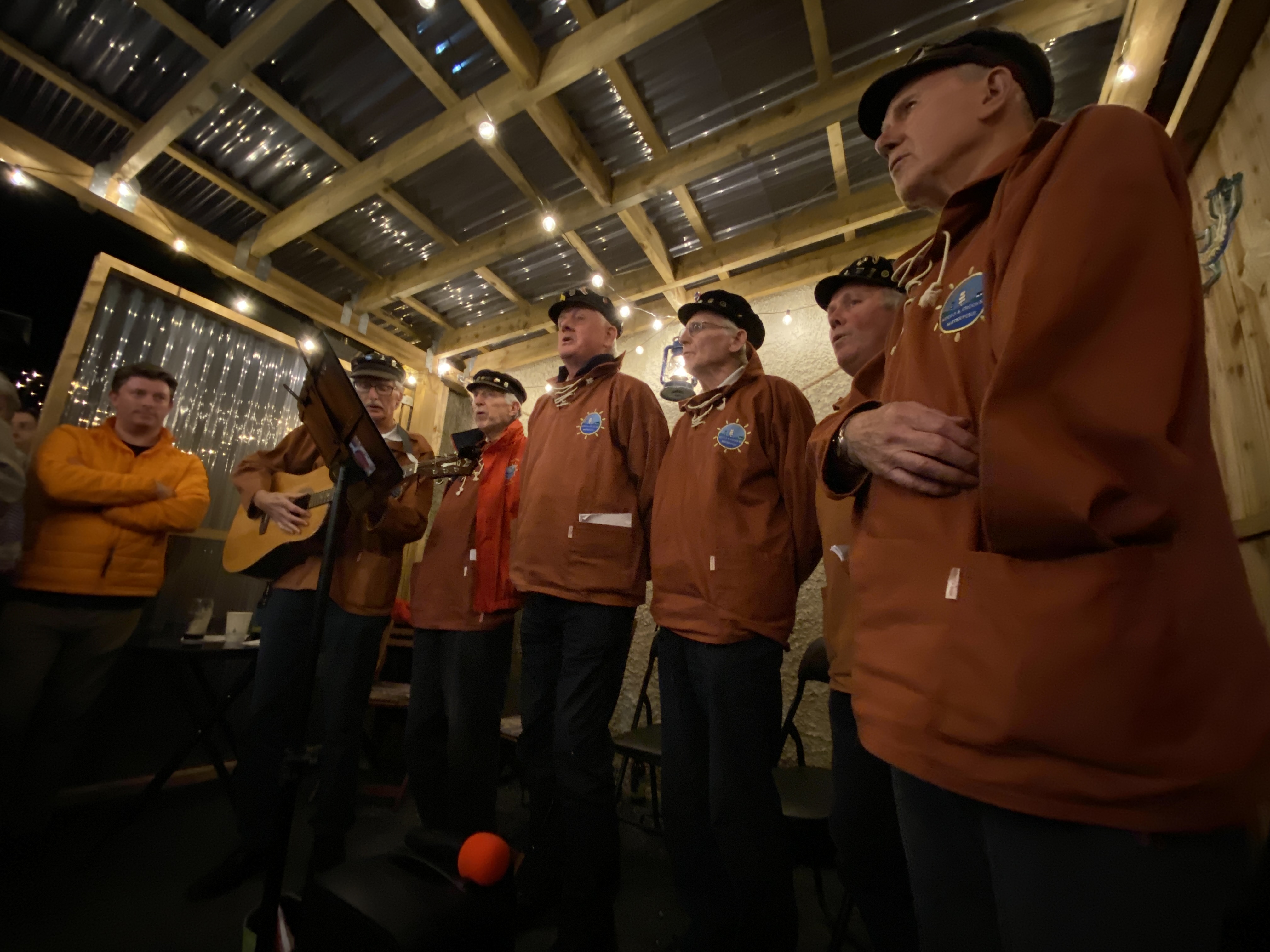
Our next event was thousands of miles distant -- at the National Maritime Museum in Greenwich in the UK. Here, Gina was able to join us (photo above), and our UK friends -- many of whom we'd not seen in two years or more -- were present; curator Jeremy Michell gave us a very fine introduction. Scarcely a day later, three of the four of us were on flights to Dublin, whence we made our way to Athy and this years Shackleton Autumn School. It was a special pleasure to see so many old friends and fellow polar enthusiasts, among them Joe O'Farrell, Bob Headland Rob Stephenson, Geir Kløver, and Medbh Gillard. Our launch there, hosted by our good friends at O'Brien's pub, was also wonderfully enhanced by a resounding version of Lady Franklin's Lament provided by the shantymen of Hooks and Crookes.

Then, in a return to Ottawa, came a further bow for us all. I was deeply honored and gratified to be awarded the Louie Kamookak medal, named after my late friend and Inuit historian, and to welcome Peter, Mary, and Gina as Fellows of the RCGS. As an added bonus, we got to meet Jared Harris, whose wonderful portrayal of Francis Crozier on AMC's The Terror we all admired, along with David Kajganich, the series' writer and showrunner! The gala dinner at the Canadian War Museum was a memorable evening for everyone present.

And so, while we don't have any further events planned at present, we're looking forward to a less far-flung holiday season -- and to those copies of our book that many (including ourselves) will be placing under their Christmas trees this year, lying in wait -- or so we hope! -- to convert more people yet to our wonderful shared obsession.

Wednesday, August 10, 2022

A look ahead to events for May We Be Spared ...

Finally, the day draws near! We're happy to announce some of the first few events for May We Be Spared -- watch this page for further details as the dates draw closer.

Our big launch will be at the headquarters of the Royal Canadian Geographical Society at 50 Sussex Drive in Ottawa, on September 26th. We're delighted that this event will also be the launch for Matthew Betts's extraordinary book on HMS Terror -- it's hard to imagine a better pairing. We're also going to be a part of the 2022 Terror Camp online event the weekend before (September 24/25) where I hear we may be joined by several cast members of the show; it will be fascinating, I think, to see these letters paired with some of the actors who portrayed their writers!

Moving right along, I'll be crossing the proverbial pond (my fellow editors being already on the other side) to the National Maritime Museum in Greenwich, for a talk and presentation as part of their series of Members events (it will also be open to the public, I believe) on October 27th. I have no doubt there'll be the usual gathering at the Trafalgar Tavern after -- we'd better reserve all the tables! 

From there, it'll be over the Irish Sea to Athy, and the 22nd annual Shackleton Autumn School that weekend. This will be the first time it's been held in person in two years, and it will be fantastic to gather again with such excellent friends -- and of course, then retire to O'Brien's Pub across the way. O'Brien's has gracefully agreed to host the official launch, so I have a feeling pints of Guinness will be involved!

We're hoping for an event or two in the US this fall as well -- plans are still being sorted out -- I'll update this post, and/or share details in a new one, as soon as they're firmed up!

Thursday, June 16, 2022

Our youngest correspondents

Among the many correspondents in our forthcoming book of letters, two of the very youngest stand out from all the rest, both for their sincerity and heartfelt feelings, and also for the sweet, childish humor that still shines forth from their carefully-penned missives.

James Fitzjames was so struck by the letters that he enclosed them with one to his sister-in-law Elizabeth Coningham, with this preamble:

"I leave you these two letters from my little friends – as I am sure any-thing that gave me pleasure will gratify you ... perhaps you will think I am foolish to care for the little children’s letters – but so it is – I am as much pleased with their expressions of regard – exaggerated though they be – as I should be with the more studied, but probably not so genuine, effusions of many grown people."

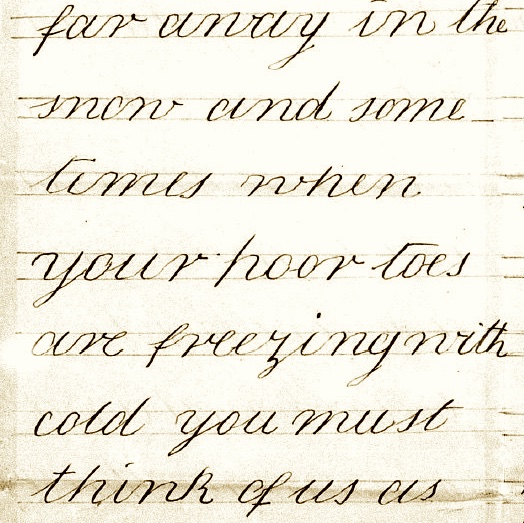
The children in question were Eliza Francis ("Fanny") and Maria Jane Campbell, the daughters of Fitzjames's friend Henry Dundas Campbell, a decorated soldier and later a colonial governor who had befriended Fitzjames early in his career, helping him secure his appointment as Midshipman in 1831. Fanny would have been around twelve years old,  and Maria a year younger. Writing in her best school hand, Fanny expressed her sentiments as well as any adult:

"I am very sorry indeed to hear you are going to leave England so soon we shall think of you when you are far away in the snow and some times when your poor toes are freezing with cold you must think of us as we shall be longing for your return."

Maria's letter was more chatty, expressing the regret that Fitzjames could not visit them again until his return, adding "I hope you will not forget us when you are in among the snow and when you come home you will pay us a nice long visit." She closed her letter "Your ever affectionately and attached friend, Maria Jane Campbell" and then added a curious postscript: "Missie says just as if you care a fig for our attachment to you."

This annoying "Missie" may well have been their older sister Harriet, who would have been about sixteen at that time, just the age for such a jovially mocking riposte. It must surely have greatly amused Fitzjames, who was always prone to jest in prose, and touched him more deeply than these young writers may have realized. He closed his letter to Elizabeth with this salutation to her and William: 
"I think the love of a child is a thing not to be thrown away lightly. 

There are some grown up people too, whose love I would not exchange for any worldly good. And of these I need not say you & William stand far highest in the heart 
of your affectionate

James Fitzjames"

Wednesday, May 25, 2022

The Engines and Engineers of Erebus and Terror

A guest post by Peter Carney

Sketch by John Irving
The steam engines Engines fitted to Franklin’s ships Erebus and Terror have long been a topic of interest to me. They were the subject of my first ever blog post in July 2010. Much of the meagre information available was gleaned from letters from officers of the expedition from the time when the ships were being fitted out at Woolwich and the engines tested in the river Thames, letters that are transcribed in full in our forthcoming book, May We Be Spared to Meet on Earth: Letters of the Lost Franklin Arctic Expedition:

 “The ships are getting on famously – our engine is down alongside. It came drawn by 10 coal black horses & weighs 15 tons.”

- James Fitzjames to John Barrow Jr, before 4 April 1845

 “ Our engine once ran somewhat faster on the Birmingham line. It is placed athwart ships in our afterhold, and merely has its axle extended aft, so as to become the shaft of the screw. It has a funnel the same size and height as it had on the railway, and makes the same dreadful puffings and screamings, and will astonish the Esquimaux not a little.”

-  John Irving to Catherine Irving [sister-in-law], 16 May 1845

There are, of course, many further questions which I hope the Parks Canada underwater archaeology unit will be one day able to answer: Were they fitted with Stephenson’s link valve gear? This important mechanism allowed the cut-off of steam admitted to the cylinder to be minutely controlled for best efficiency or maximum power. Did they employ Isaac Babbitt’s patent bearings? -- a development which increased by more than tenfold the mileage a locomotive could do before its axle bearings needed overhaul. Was the supporting structure made of wood or cast iron?

The rich trove of new material assembled for May we be spared to meet on Earth, fascinating as it is, doesn't offer any further answers to these questions. They are frankly not the sort of details that departing explorers would put in their last letters to their families and loved ones. However, and perhaps even more interestingly, they do provide an insight into the personalities of the two men charged with the care and operation of the steam engines and they highlight the contrasting attitudes which the two captains held with regard to both the engines and to the engineers.

Franklin was certainly forward looking in his enthusiasm for steam power:

 “I meant to have had the steam up here to see that all was right – but we really could not at present spare either the space or time. We are satisfied however that all is right and kept in order by the Engineer and it is my intention to take the first opportunity of our being beset to get the steam up, and certainly have every thing ready for its immediate use by the time we reach Lancaster Sound. We find our Engineer Mr Gregory a good & valuable man – and willing to do anything required of him.”

- John Franklin to Edward Parry, 10 July 1845

This “good & valuable man” was Engineer, First class, John Gregory.

John Gregory was not a Navy man and nothing suggests he had ever been to sea before he joined the expedition. Instead he had been employed by Maudslays, the firm contracted to supply and fit the engines for Franklin’s ships. No doubt he was supremely competent in his trade and highly thought of by his employer to be entrusted with such an important task.

Gregory’s sole surviving letter to his wife, sent from the Whale Fish Islands, contains a detailed and well written account of the voyage so far with affectionate greetings and thoughts for the children. The elegant yet easily readable handwriting is particularly noteworthy. 

The fraying folds in the paper and the patches of discolouration tell the poignant story of this letter being passed through many pairs of hands across the generations of his family beginning with his wife and the five children he left behind.

In March of 2021 it was announced that a team led by Douglas R. Stenton had matched DNA extracted from human bones found in previous years on King William Island to living descendants of John Gregory in South Africa. This is the first time that the remains of an expedition member have been positively identified.

Crozier’s feelings towards steam stand in contrast with those of his commander:

“how I do wish the Engine was again on the Dover line, & the Engineer sitting on the top of it, he is [a] dead and alive wretch full of difficulties and is now quite dissatisfied because he has not the leading stoker to assist him in doing nothing...”

            - Francis Crozier to Ann, wife of James Clark Ross, 12 July 1845

The “dead and alive wretch” in this case was Engineer, First class (acting), James Thompson

Thompson’s letters to his brother Charles are not as elegantly worded as Gregory’s example but the excellent handwriting shows he was a diligent student, except with regard to punctuation.  His letters are packed with myriad details of the voyage to date from the quantities of foodstuffs provided each day to descriptions of the inhabitants of the Whale Fish islands. Indeed, Thompson comes across as one of the more compassionate observers of the Inuit who were encountered, referring to them as “A harmless set of People and very honest.” Gregory, too, describes them in similar terms so perhaps both engineers’ working class roots gave them a greater affinity for a people who led a precarious struggle for existence.

It seems that Crozier's lack of enthusiasm for the new technology of steam power was shared by many in the Navy.

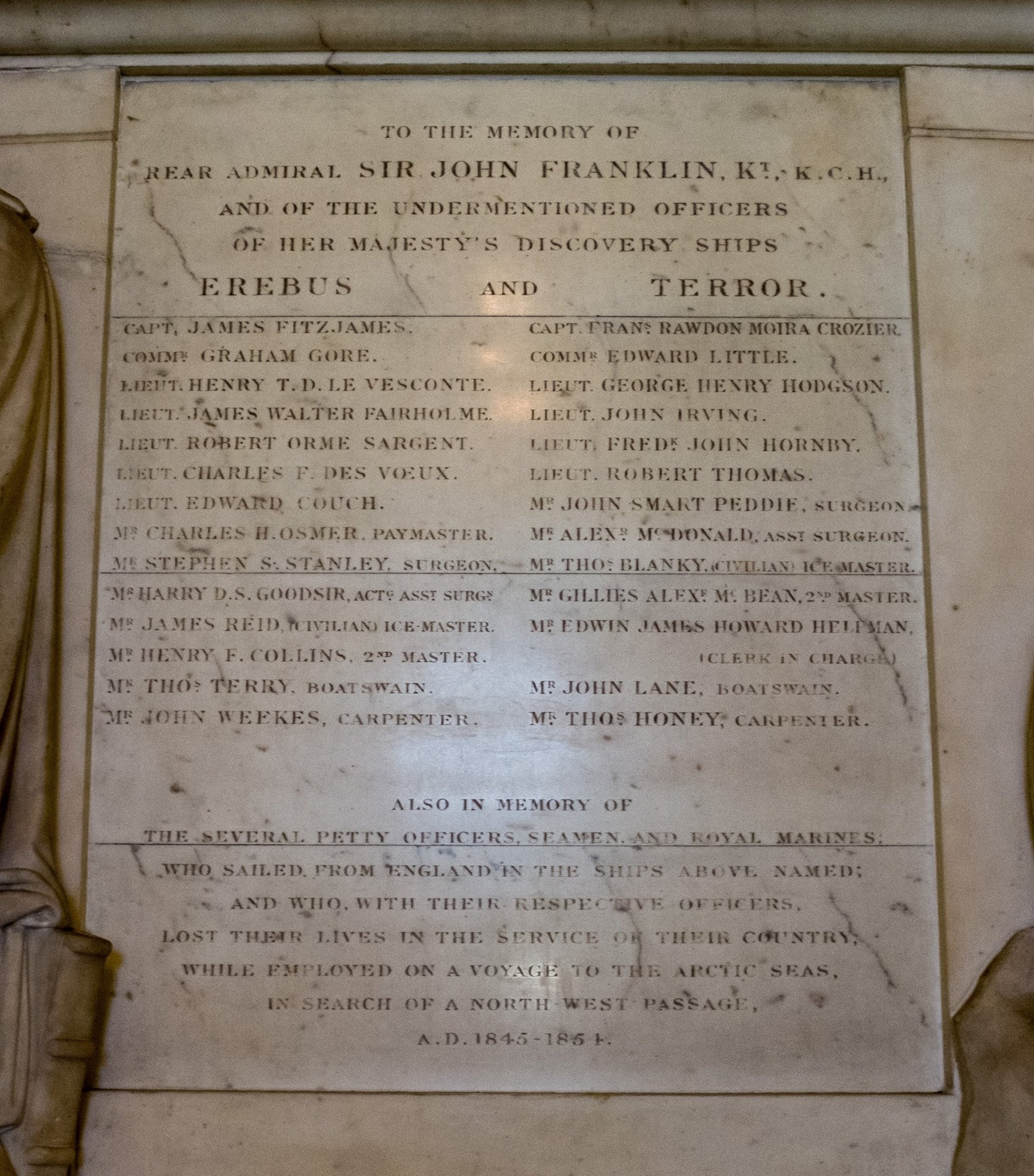
The tablet from the Greenwich memorial
The Engineers of Erebus and Terror were highly skilled artisans and plausibly had a higher standard of general education than their fellow Warrant Officers the Boatswain and Carpenter in each ship. However, many officers in the Naval hierarchy were cut from an older type of cloth. Enthralled by the sublime beauty of the sailing warship and the glorious memories of Nelson's victories, some viewed steam engines as infernal machines and their operators as uncouth tradesmen. This attitude seems to have prevailed when the monument in the chapel of the Naval College at Greenwich was erected in 1858.

The names of all the commissioned officers are inscribed on this monument, as well as the four other warrant officers. It therefore seems to me unjust to me that it omits the names of John Gregory and James Thompson, the engineers of Erebus and Terror.


Friday, May 6, 2022

James Reid Speaks!

In my last post, I gave some previews of the remarkable letters of James Reid, the Ice Master of HMS Erebus, as they will appear in our forthcoming book. Now, I have something even more exiting to share: thanks to the great generosity of Dundee native Gordon Morris -- who memorably portrayed John Weekes, the ship's carpenter aboard that same vessel in AMC's The Terror -- we can now hear some snippets from Reid's letters in the accents of their original writer! A Dundee accent, Morris explained to me, is not all that different from an Aberdeen one -- it's just "a wee bit further up the northeast coast" -- and, heard here in its original tones, Reid's seemingly irregular spelling now reads as nearly phonetic. And more than that: as with many who have so far listened to these recordings, I had the eerie sense that Reid himself had, as it were, returned from the past, as alive as the day in May of 1845 that he sailed down the Thames with Sir John Franklin and his men.

I've arranged the excerpts in chronological order, mainly so that the context of Reid's words will be clearer; each is linked alongside the original text of the letters.


22 March 1845 -- the "Neptune" was a ship previously captained by Reid; he apparently had already made up his mind to sail with Franklin.


8 Smiths Place High Street Wapping March 22/45

Loving wife,

I hope you have received my yesterdays letter with the one pound chake from William –
There is a Letter come from Quebec from the Owner stating that if Captain Reid can be found to get him if not engaged to take charge of the Neptune and sail for Quebec 1st April – now you see how mean some Scotsmen is to pay a Master off for a few weeks. I called on them to day and told them that i wase engagen with Sir John Franklin R.N. to go with him to the North as ice Captain, but I would give them an answer on Tuesday. During th[at] time i will call on Sir John, at Woolwich, [and] if he puts me on pay just now @ £18 pe[r Month], I fix and I take my chance of the Voyage. I go [as] Master & Pilot, it is sure pay and good company. I dined with all the officers, we can find no servant, we must find one amongst [us]. You will have half pay, if I should never return, then there will be something for you and the family. Mr. Enderby will see after that what I have mentioned all Depends on putting me on pay just now, if not I take command of the old ship.


26 March 1845 "I shipped yesterday"-- "thoughts of your leg" -- Ann Reid had been nursing a sore leg.

so now I Shipped yesterday with Sir John Franklin R.N. to go with him to Daviss Straits, and up Langester sound in search of a passage through, it may be two years and it may be three & four but I am quite willing to go. It is no use lying at home being allwise in measurie the thoughts of your leg and leaving the family is worse than the Voyage. Sir John told me that if I went the voyage with him, and landed safe in England again, i would bee looked after all my life. The ship I go in is the Erebus, and the other is the Terror. just such ships as the Hecla but not Quite so Large. Sir John is a man 60 years old. Quite a Hero he is very fond of me as is the officers, as i answer all the quistences they put to me about the Land and ice about the Quarter we are going to.


13 May 1845 "The Black Ladi" -- this refers to the medical exams for the crew; those that were "casten" were deemed not fit to serve. The "Black Ladi" was likely a young Black seaman of the day.


Mr. Valentin[e] wase casten for the Scurvey in his Leges and the others for several things an the Black Ladi wase casten for his Leg having once Broken. – – I Received a Letter from aunty at Dundee mentioning she had Received the four Pound, I would like to here if you have Received the Money. in all sent £4[...] I will write before I Leave the River.
Remains,
your Loving Husband

James Reid


16 May 1845 -- Mind yourself -- This letter seems to be an admonition to his wife Ann to be careful in her family dealings -- particularly with their sons -- during his absence.

Loving wife, mind yourself. Dount you trust to one of them for as soon as they can do for themselves they will never mind you nor me, you dount see so much of the world as I see. Let them from Home, then the Chief Part of young men Forgets there Parents and friends. Take all but give nothing, mind this Take care of yourself & the three young Lasess they are not able to mind themselves. –


19 May 1845 -- The day of sailing [full letter] "Finlason" was a tailor in Aberdeen to whom the Rieds apparently owed some money. David Leys did sail with the expedition, but not as Quartermaster.

Green Hithe London River May 19th/45  

Loving wife
we are now all clear for a Start. will sail to day we are to bee towed with steam Down to the orkness – Lady Franklin hase ordered all the officers Likeness to bee taken and mine amongst the Rest, with my uniform on – She keeps them all by herself – Sir John Franklin Gave us prayers yesterday his Lady wase in Company, your order will bee sent to you when due. I got 6 Month’s Pay – I joined the Erebus 27 March, bee sure and Call on Mr. Finlason the Tailor and make arrangement with him, you know more about his account than I do, once you are underway with your half pay, you will bee abale to pay him part Every month, once you get the account below twenty pounds he canat Hurt you – the other Ice Master wase taken out of the ship for £37, but I Rather think he hase got it settled, we paid the Ships Comp[an]y on Saturday last. David Leys is not Quartermaster. I have nothing more in the meen time will write by the steamer if we dount go into the orkness. 

Good Biy keep your hart up we will both meate again, this voyage perhapes will [be] the last that ever I make. I have nothing to doo my work is Coming. I am sorry to say I am badly of[f] for Quarter Masters, and we are the leading ship, it will keep me much on my legs – I think I have Every thing Right but short of White Shirts, and whate I have are Quite gone. This Leave me Quite well. Hopes it will find you and the family the same, by this time you have Received my Chest. –

Remains
your Loving Husband

James Reid

3 June 1845 -- "your old Gray Hare" (from Stromness, Orkney) -- Reid had apparently asked his wife for a lock of her hair in an earlier letter.

You mention that your old Gray Hare wase not worth the sending to me, I cane only tell you that your old gray Hare is as good to me as ever, and I would [have] been very Happy if you hade inclosed one Lock of it.

Sunday, May 1, 2022

The Letters of James Reid

Of all the officers of the Franklin expedition, James Reid was one of the most lively and colorful.  As James Fitzjames remarked of him in the 'journal' he sent to his sister-in-law Elizabeth Coningham, "The most original character of all. rough, intelligent, unpolished, with a broad North Country accent, but not vulgar – good humored, & honest hearted – is Reid – a Greenland whaler – native of Aberdeen – who has commanded whaling vessels & amuses us with his quaint remarks & descriptions of the ice." 

Reid's own letters, however, proved far more elusive than Fitzjames's; although his family in Australia (to which his daughter Ann had emigrated) searched for them for years, they seemed to have gone entirely missing. A few years back, my friend and colleague Andrés Paredes found excerpts from some of them in an Australian newspaper from 1920; until then, they had still been in family hands. The newspaper articles spoke of them having been given to the "National Museum" in Adelaide (now the South Australian Museum), but that entity had no record of them.

Until scarcely two years ago, these excerpts were all we knew; that and all other queries to research libraries in Australia turned up nothing. And then, like a bolt out of the blue, our fellow Franklinite Alexa Price found a listing for them in the online catalog of the State Library of New South Wales! This was a surprise on many levels; Reid's daughter had emigrated to Victoria, not New South Wales, and at the time the letters had been reported in the press in 1920, they were in the hands of one of Ann's nieces. They showed the letters to a certain Dr. W.P. McCormack, a physician with a practice in Tumby Bay; it was he who recommended their donation to the museum. But how then did they end up in New South Wales? Some years previous, I'd checked the online catalogs of all the state libraries, and there no listing was to be found -- so my best explanation is that the record showed up when the SLNSW's old card catalogs were digitized and combined into a new, comprehensive one.

Scarcely a week later, our digital request was processed, and there they were; with help from Reid's great-great-great-grandson Rick Burrows we were able to cover the cost of high-resolution versions a few weeks after that. And what a revelation! Not only was Reid distinctive as a character, but as a writer; his odd spellings in some cases seemed to reflect Scots usage, but were often his own invention: "was" became "wase"; "well" was often "will"; "stop" became "stope"; and "job" "jobe." His ear for names produced interesting results, as when Blanky, his fellow Ice Master over on HMS Terror, became "Brinkly." These oddities aside, his rich personality is everywhere in evidence, from his first letter of 22 March (when he tells his wife of his plan to join the expedition) to his final one on July 11th. In all of them, he asks after his children, particularly his "three Darulins" (the Reids’ youngest children, Ann (1833–1899), Mary (1835–1909), and Alexandrina (1838–1901). At one point, apparently, seven-year-old Ann wrote to him herself, as he thanks his wife for "Anns most welcome Letter" -- alas, that note was lost with the ships.

We can see him pondering his fate, and weighing the success of the Franklin expedition against other possibilities; unlike Naval officers, whaling captains were freelancers of a sort, competing for available commands and trading on their experience and connections. Reid had a particularly close relationship with the whaling firm of Samuel Enderby and Sons, and asked them to look after his family in the event he did not return. He was aware of the risks, and of the possible envy some might feel toward him, saying "No doubt there will bee a greate talking about me going this voyage, it will show that I am not frightened for my life, like some men." Most poignantly, he seems to have asked his wife Ann for a lock of her hair, which she declined to send, saying it was too gray. This prompted James to write:

You mention that your old Gray Hare wase not worth the sending to me, I cane only tell you that your old gray Hare is as good to me as ever, and I would [have] been very Happy if you hade inclosed one Lock of it.

As to his shipboard comrades, Reid speaks of them in admiring tones, and particularly seems to have formed a bond with young Harry Goodsir, who was assigned to the neighboring berth. "Him & I is quite chief," he wrote (chief being a Scots word for a close friend) and marveling that Harry had never been to sea before. And throughout his correspondence, his deep love for Ann and his family comes through in every word. His very last letter, sent from the Whalefish Islands, ends thusly:

Respects to Robt., Forbes, and all Friends, may the Lord bee with you and my Dear Family, for three years if not through before that time, keep yourself easy about me. Trust wee will meet Again. Remember me to William Gaudy wife & family Bidding you all Good By.

Remains your loving Husband

James Reid

Monday, April 11, 2022

Uncle Roddy

A guest post by Mary Williamson, co-editor of May We Be Spared to Meet on Earth

Roderic Fenwick-Owen (1921-2011) or “Uncle Roddy” as I knew him, is probably best remembered by Franklin enthusiasts as the author of The Fate of Franklin  (Hutchinson, 1978), an exhaustive biography of his three times great Uncle Sir John Franklin. But his writing career had started thirty years previously with a history of the Desert Air Force (Hutchinson, 1948) and a couple of novels, The Flesh is Willing and Easier for a Camel. The novels are probably best forgotten, but The Desert Air Force fared better and was reprinted in paperback. It led on to a biography of Lord Tedder, who had written a Foreword  to The Desert Air Force. Roddy interviewed him in Washington & then descended on New York. Through a mutual friend from Oxford, he was offered the use of a house in MacDougall Alley, a mews off Washington Square. He just had to be let in and given a spare key by Jackson “something-or-other” (Pollock!) who was living in the studio upstairs. Roddy had no idea how well regarded Jackson Pollock was, so when he was offered one or two paintings to take back to England (“a frightful daub”) he refused! In later years he would admit to regretting this hasty decision.

Roddy had a privileged childhood, being sent to Eton which he always claimed to have hated, but the contacts he made there & later at Oxford would prove invaluable to him on his travels all over the world. It would be wrong, however to imply that money was plentiful. Roddy’s father George Fenwick-Owen had inherited sufficient money to lead a comfortable life, but lost everything in the financial crash of 1929, and to make matters worse, he then ran off with the governess, leaving Roddy & his two sisters to be brought up solely by their mother Bettina. She famously claimed that she had to make do on what was previously her “dress allowance”. 

But travel could be managed on a shoestring, particularly when there were contacts who could secure a passage on a ship to far flung destinations. Through a friend of a friend, Roddy ended up as Assistant Purser on Clan Urquhart, a cargo ship travelling from Liverpool to Sydney, from where another friend used his influence to get him onto a cargo boat for Fiji. Roddy then spent a year beachcombing in the South Seas, during which he was seduced by, and married, a Polynesian princess called Turia. He left her and moved on, publishing his experiences when he returned to England in his first travel book Where the Poor are Happy (Collins, 1954) along with two more novels set in the South Seas, Green Heart of Heaven and Worse than Wanton.

Roddy’s particular interest in John Franklin began in the early 1970’s. His Aunt Susan, widow of Uncle John Rawnsley, who lived at Well Vale, Lincolnshire, expressed a wish to give “her” collection of books on John Franklin to Lincoln County Library. Roddy pointed out that they weren’t hers to give. They had been inherited by his grandfather Walter Rawnsley, then passed to his wife Maud & from her to Roddy’s mother Bettina, but without having been removed from Well Vale. The deed had already been done, but Roddy turned on the charm and managed to extract them from the County Librarian, and on reading through was well & truly hooked. 

“Day and night, the North-West passage haunted me” he wrote in his memoirs. His recent biography on the life of Mavis De Vere Cole, Beautiful and Beloved (Hutchinson, 1974) had been well received, which left him in a good position to ask his agent Ann McDermid, her immediate reply being: 

“John Franklin? – You mean Benjamin Franklin, don’t you?”  

“No, John. Sir John of the Frozen North!”  

“Oh, that one … we know a lot about him in Canada, of course. Well I can always put it up to Hutchinson’s”

And Hutchinson’s reply “Well, I think that’s absolutely splendid Roddy …” made it all plain sailing!

“I ought to visit the Arctic, if I’m going to write about it properly” were Roddy’s thoughts in 1976. He mentioned his predicament to his brother-in-law by marriage, a former Ambassador to the Holy See, who remarked “Why not get someone to send you there? It shouldn’t be beyond your ingenuity!” As it happened, August 1976 was the 150th anniversary of Franklin’s arrival at Prudhoe Bay, on the second land expedition. Roddy contacted BP, who were already interested in celebrating this event and were delighted to involve a descendant of Sir John Franklin. They wanted a monument in Anchorage, Alaska.

Roddy suggested using just the head of the Franklin figure standing on a plinth in Spilsby Town Square. Nobody had ever seen his head at eye level before. (Russell, Gina, Steve & I located Franklin’s head in Anchorage in 2019 & Steve took this photo) A further plaque would be placed at Deadhorse Airport, for which Roddy agreed to compose the words, make a short speech & unveil it. 

Roddy managed to visit various key places, the first being Franklin’s furthest point west at Return Reef. It seemed likely that the reef had been washed away, so the helicopter landed on Stump Island nearby.  Next on the agenda was Winter Lake by seaplane, to locate the site of Fort Enterprise. Roddy remarked in his memoir “The whole settlement had disappeared, almost without trace …. Even when sitting on the site of Fort Enterprise I found it impossible to reconstruct the Franklin party’s experiences realistically. Nothing fitted my preconceptions. Things as I’d thought they would be, had to be replaced by things as they were. I felt a distinct sense of loss.”
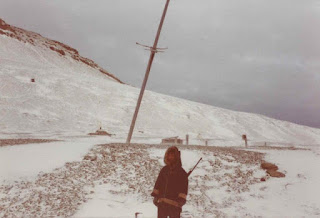
Owen with the mast of the Mary
Roddy was taken to Beechey Island with a fishing party of Americans who were going on to Cresswell Bay. He & his Inuit guide Andrew were left on Beechey at 7:30am & remained there until picked up by the twin otter at 4pm. They had plenty of time to explore – Roddy  noted “the spar of John Ross’ ship “Mary” sticking up at an angle.” They attempted to climb to the top of the hill to see the cairn, but it was too much for Roddy & he had to signal to Andrew “who must have thought me a proper softy”

 I remember Roddy being particularly pleased to get the contract for The Fate of Franklin, because, as he explained to us at the time, “I can now write the book that I want to write”  Roddy always acknowledged the help he received from the mystical “Unseen”. He used to tell us that when faced with a huge pile of papers, an unseen presence would guide him to the right folder. He believed this to be the spirit of his great-uncle Willingham Franklin Rawnsley (1845-1927), great nephew and Godson of Sir John, who wrote The Life, Diaries and Correspondence of Jane Lady Franklin (1923).

In spite of Willingham’s ghostly presence, Roddy’s methods of research were somewhat haphazard. His desire “not to pepper the text with little stars” led to the main criticism of his book, which was his total lack of sources, either as footnotes or a separate list.  As for filing and maintaining research material afterwards, this was also hit & miss, as he explained in his memoirs: 

“It had always been my habit to jettison the huge quantity of facts involved in writing any biography as quickly as possible; otherwise I might have gone mad”

Exactly how much was jettisoned is impossible to know.

After Roddy’s death I found letters from researchers amongst his papers enquiring about sources post publication, along with copies of Roddy’s replies, most of which supplied absolutely no information, albeit very politely! In spite of this, Roddy was always very accommodating towards Franklin researchers. A young Dave Woodman was given lunch & shown Roddy’s precious Staffordshire figures of Sir John & Jane Franklin, as well as being taken to the Royal Geographical Society Library. 

I think Roddy was disappointed that there was no separate American edition of his book. 

In a letter to author Sten Nadolny (The Discovery of Slowness, Viking Penguin 1987) in 1981, he wrote: 

“The Fate of Franklin … did well but not very well. I wasn’t nearly as successful as Jane Franklin in enlisting American support”

Although he often claimed to have forgotten everything, Roddy’s interest in Franklin remained and he was pleased to be asked to give an address at the Naval Chapel, Greenwich, in 1986 to mark the bicentenary of Sir John Franklin’s birth. 

Gilston Lodge
One of Roddy’s greatest inherited treasures was the last known letter written by John Franklin to his wife from the Whale Fish Islands, and one of the letters in May we be Spared … We failed to locate the letter before Roddy died, he couldn’t remember anything about it, so there was a great hunt for it afterwards. Eventually and very appropriately, it was discovered tucked into the back of Willingham Rawnsley’s draft copy of “The Life, Diaries and Correspondence of Jane Lady Franklin”. We found it in the small attic room above the Tower Room at the top of Gilston Lodge. Accessible by ladder only, the room was boiling hot in summer, freezing cold in winter and home to numerous ladybirds who seemed to have chomped through a good deal of photocopied material but left Willingham’s draft undisturbed.

Visiting Roddy at his house in London (Gilston Lodge) was always an experience. Meals were eaten in the kitchen, at a small table with huge winged chairs, all taken from a Victorian railway carriage, complete with brass lamps & polished brass luggage rack above. There was always a dog, the most recent one being a shih tzu called “Lovey” who had been notoriously difficult to house train but was adored nonetheless. 

There was a very particular morning routine. After breakfast, Roddy would help the dog into the back of the car (never the boot!) and we would drive to Chiswick Park for a walk, the route being entirely decided by the dog. Whichever path he chose to go down, we would duly follow. 

In the 1990’s Roddy started writing his autobiography, which ended up as three large volumes. His desire for truth, warts and all, laid bare his pursuit of love for both sexes. It was a life of joyous promiscuity until he met the love of his life in 1967, an Italian man named Gian Carlo Pasqualetto. Roddy preferred London to the countryside, though he did risk the occasional visit to my parents farm. It always amused us that someone who had been stranded in far flung places & coped with all manner of tricky situations was unwilling to subject his smart London car to a ½ mile driveway of potholes, brambles & cowpats. But that was all part of Uncle Roddy’s charm!

Gilston was always full of people. There was a lodger on the top floor for many years, a couple in the basement, and of course Gian Carlo. No-one in the family ever commented on their relationship and we were left to work it out for ourselves. When his three autobiographical volumes were printed privately, Roddy was most disappointed that we weren’t more shocked by his many revelations!

Roddy appointed two Literary Executors to administer his literary estate, with the express wish that his autobiography be published after his death. “I would be most unhappy to think that any parts of this long memoir should be cut on grounds of “decency”, for those bits are essential”

The length of the combined volumes meant that inevitably, some bits were cut, but two paperback volumes Travels of Delight and Tours of Delight edited by Nigel Hart were published by Langney Press in 2016. A more recent version which included more of the “essential” bits was edited by Emily Barrett of Little, Brown Book Group & published by Sphere in 2021 under the title Oh, What a Lovely Century

When our own book, May we be Spared to Meet on Earth: Letters of the Lost Franklin Arctic Expedition required funding, I approached the nearest Literary Executor, my brother Charles. Both he and his co-executor agreed that Roddy would have been delighted to help out, so a cheque was duly handed over to me, with a bust of Sir John Franklin in the background looking on approvingly!