Monday, September 26, 2016

HMS "Terror" find confirmed!

Parks Canada photo
As most of us expected, Parks Canada today confirmed that the wreck first located on September 3rd by the research vessel Martin Bergmann is, in fact, HMS "Terror," the second ship of Sir John Franklin's 1845 expedition. The Parks team had to deal with rough weather, which churned up a fair amount of silt and made visibility poor, but despite this were able to examine enough of the ship to, having compared it with the detailed plans they have at hand, make the identification definite.

Much of the press release, though, was devoted to highlighting the new degree of co-operation between Parks and various Inuit groups -- Inuit Heritage Trust, the Kiktikmeot Inuit Association, Nunavut Tunngavik Inc., and the Government of Nunavut. This is a crucial aspect of the find, and --as I noted in my blog a couple of weeks ago -- is something that has been in the works for a long time. It was evident, in the time between the initial discovery and Parks's statement, that many Inuit still felt anxieties over how the site and the relics found there will be treated, but today's announcement should, I hope, be reassuring. As I've mentioned, my personal view is that the wrecks and their contents technically aren't covered in the Nunavut Land Claims agreement, but the willingness of the present Government to treat them exactly as though they were, and to commit to ongoing cooperation, is nevertheless the right thing to do.  There's property, and then there's cultural property, and it's clear that the "Terror" and "Erebus" are sites which enshrine, embody, and contain, the history of both Inuit and European-origin peoples. Like cords in a vast fish-net, they are too enmeshed in one another to be separated, and for the goal of the proper conservation of these vessels to be met, they must work together.

The fact that "Terror" owes its discovery not simply to the historical Inuit testimony collected by Rae, Hall, and Schwatka in the 1850's, '60's, and '70's -- but also to that of Sammy Kogvik, a present-day Inuk who led searchers to the site -- underscores the rightness of this arrangement.

But there is work to be done. It's encouraging now to know that the Parks Canada team can spend the still-brief search window next summer actually working on both ships rather than searching for them. The apparently much better state of the decks and great cabin of the "Terror" suggests that this might be the place to start; what we need now is not only the everyday items that have already been spotted, such as a bottle of wine or a desk drawer -- but the written records that will certainly be found. Will they be as enigmatic as the infamous Peglar Papers? Or will we get an accurate ship's log or other official record, which would certainly change what we know about the final fatal months or years of the expedition? For those of us who have already spent a large chunk of our lives wondering, it will be a long year!

Sunday, September 18, 2016

Inuit testimony about HMS "Terror"

As we await further word about the finding of HMS Terror, I thought it useful to collect together the principal Inuit witness as to its fate. Now that we know, at least, its general location, we can use that to help us separate out some stories from others, and eliminate from consideration accounts which place the ship elsewhere.

The first person to hear reports that now clearly correspond with the Terror was, ironically enough, Francis Leopold McClintock -- the man who discovered the last known written record, and the man who gave "Terror Bay" its name, apparently unaware that one of the ships he sought so dearly lay beneath the surface only a few miles from where he stood! I should caution that this testimony has an issue -- Petersen, McClintock's translator, was clearly not familiar with the local dialects, and so one has to build in the possibility of misunderstandings.

On King William island, about "halfway down the east coast," McClintock came upon a village of 30 or 40 natives, apparently well-supplied with wood as well as sundry artifacts from Franklin's men; McClintock saw there a sledge with large, curved wooden runners "which no mere boat could have furnished them with," a sure sign that they had come from the wreck of one of the ships.

After obtaining items in trade -- six silver forks and spoons, some buttons, and "bows and arrows of English wood," McClintock asked about the ships. They had seen two ships, yes, one of which sank quickly before they could get anything from it, and the other of which had been "forced up on shore" and much broken -- it was from this latter ship that the wood had come.

The other stories McClintock heard came from "old Oo-na-lee," who initially told of only one ship, but on a second occasion -- after a younger member of the band mentioned a second, admitted its existence:
"Oo-na-lee now answered our questions respecting the one forced on shore; not a syllable about her did he mention on the former occasion, although we asked whether they knew of only one ship ? I think he would willingly have kept us in ignorance of a wreck being upon their coasts, and that the young man unwittingly made it known to us."
The young man added further details:
"The latter also told us that the body of a man was found on board the ship ; that he must have been a very large man, and had long teeth: this is all he recollected having been told, for he was quite a child at the time. They both told us it was in the fall of the year — that is, August or September — when the ships were destroyed ; that all the white people went away to the " large river," taking a boat or boats with them, and that in the following winter their bones were found there."
It's easy to imagine why Oo-na-lee might have wished to conceal the second vessel, as that one had been a source of immeasurable wealth in wood, metal, and useful things. So here in this earliest account, we have two ships: one that sank quickly in deep waters with nothing recovered, and one that was, for a time, forced up on land and "much broken." It's clear that the one that sank rapidly must be the Terror, and the latter the Erebus -- a correspondence further confirmed by the mention of the dead body with the long teeth, which is nearly identical to the account of the one eyewitness we have who actually had visited this vessel: Puh-too-rak, who spoke with Schwatka some twenty years later. The quick sinking of the one vessel was also later corroborated by Kok-lee-arng-nun when interviewed by Charles Francis Hall:
"[Kok-lee-arng-nun] and his wife agreed in saying that the ship on board of which they had often seen Too-loo-ark was overwhelmed with heavy ice in the spring of the year. While the ice was slowly crushing it, the men all worked for their lives in getting out provisions; but, before they could save much, the ice turned the vessel down on its side, crushing the masts and breaking a hole in her bottom and so overwhelming her that she sank at once, and had never been seen again. Several men at work in her could not get out in time, and were carried down with her and drowned. On this account Ag-loo-ka's company had died of starvation, for they had not had time to get provisions out of her.
Again, this can only by the Terror, since the vessel which had been the source of wood was not seen to sink, but discovered after it had been abandoned. And yet, now she has been found, and apparently in good condition! But looks can be deceiving, as I mentioned in my previous post; a sudden breach in the hull would minimize the time that ice pressures would have to damage the deck and superstructure. What we really need to do next is to get a full survey of the Terror site, including a complete view of the hull; based on the extraordinary accuracy of the Inuit testimony so far, I'm willing to bet that it will show signs of sudden crushing, not unlike that which sank the Breadalbane.

Oh, and one other thing: there will be bodies. 

Wednesday, September 14, 2016

HMS Terror: What we know -- and what we don't

With the excitement around the discovery of HMS "Terror" -- a discovery yet to be fully confirmed by Parks Canada -- there's been all kinds of speculation in the press and online as to the meaning of this astonishing find. Scholars, such as myself, are as eager for new revelations as anyone else, but we've learned to practice caution, and to distinguish speculation from careful reasoning based on direct observation. Even then, what we see must be corroborated with what we know from other sources, be they ship's plans, historical documents, or (in this case) Inuit testimony. It's a process which doesn't happen overnight -- but of course the news must, and does.

None of this work has yet been done, but here we are, presented with dramatic images and video. Of course, the imagination is stirred by such sights: there is the deck upon which Crozier must have stood, the wheel where the helmsman would have executed his commands, and -- though we've no photo of it yet -- perhaps his desk, with something hidden in the recesses of a drawer. The remarkable state of the preservation of these things has led many to say the ship was found almost intact -- but that's not necessarily the case. The hull, particularly the keel, has yet to be properly examined by Parks Canada's marine archaeologists, and given the lateness of the season -- new ice is already forming in the shallow areas along the coast of King William Island -- that may have to wait until next year. In fact, it's not clear from the current reporting that Ryan Harris and his team have yet had access to the ship at all.

Some reports this morning speak of Parks Canada perhaps not having 'reached' the area, which is troubling. It appears that they were, at the time of the discovery, searching further north in the Victoria Strait; one would have expected that they would have been immediately alerted to the find, and could have arrived fairly quickly -- but the only video, the only descriptions we have so far are all from the crew of the Martin Bergmann. The video is narrated by almost every one of them -- including the ship's cook! -- but the context that a trained archaeologist could have provided is missing. The crew apparently deployed a ROV (remotely operated vehicle) and poked about all over, but the narrative of what they saw, like the discovery itself, remains uncorroborated.

There's been a claim that the "Terror" was listing to starboard -- then a statement that it was actually upright -- then a claim that she must have "gently slipped to the sea-bed." There's even speculation that her presence in Terror Bay is evidence that she was abandoned in an orderly manner so that the men could be moved to the "Erebus," which as we know made it further south. But we have absolutely no evidence for this; the hull has not been examined. I might mention at this point, the Franklin search ship HMS "Breadalbane," which was nipped by the ice and sank in scarcely twenty minutes -- and yet, strangely, when found by Joe MacInnis in 1981, she was similarly found erect on the sea-bed, her masts intact -- one of them still with a sail or two -- and the ship's wheel intact. It may in fact be the rapidity of the sinking which had the effect of preserving certain features; being found intact on the sea-floor, it would seem, is not necessarily evidence of having arrived there gently.

And there is another vital piece of evidence as to how HMS "Terror" sank -- the Inuit testimony which, in nearly every other case, has proven reliable. And the Inuit tell of a far more chaotic and sudden event, one in which a number of the crew were trapped in the vessel and drowned. In my next post, I'll give their account.

Monday, September 12, 2016

HMS "Terror" found at last!

It's hard to overestimate the significance of this new and magnificent find: the second ship of Sir John Franklin's expedition, HMS "Terror," has been found. Initial images show her to be in far better condition than her sister ship, the "Erebus" (found by Parks Canada searchers in 2014), with her hatches battened, her bowsprit still in place, and many of the glass panes in her captain's cabin still intact. It's enough to warm the heart of any marine archaeologist -- or perhaps give them a heart attack! -- certainly a discovery that exceeds anyone's (mine included) wildest imaginings as to the vessel's state of preservation.

Initial accounts are short of precise details, and it's far too early to speculate as to exactly how this might revise our understanding of the final stages of the Franklin expedition. The ship-shape status of the vessel certainly indicates that she was left behind during a stage at which naval discipline and order were still intact. And yet, at the same time, we don't yet know the nature of the damage that brought her to the bottom. What we do see -- a vessel piloted to this location, and sunk within view of shore well to the south of the initial abandonment in 1848, vindicates the Inuit testimony as well as David C. Woodman's view that, based on said testimony, either or both ships must have been re-manned (I'd say both, at least for a time). Some press accounts speculate that after "Terror" was left here, the remaining sailors sailed further aboard "Erebus," but we don't yet have any clear timeline. The discovery of a "desk with open drawers," however, points the way to one possibility: some dated document -- almost any would do -- on board either vessel could sort things out in a jiffy. The far better state of preservation of "Terror" suggests that it would be the place to start.

The location is almost too ironic for words -- having the "Terror" found in Terror Bay seems, on the surface, even more bizarre than in the 2014 parody account on This Hour Has 22 Minutes, in which the fictitious "Inuit storyteller" Philip Ayarowaq, drily noted that “the elders tell of a ship of white men that was stuck in the ice off Queen Maud Gulf, or as we call it, ‘White Man’s Sinking Spot.’” How the ship could have escaped notice, so near to a shore where dozens of searchers passed for decades, is difficult to explain. Its presence there completes a weird symmetry, as on the opposite side of the Graham Gore Peninsula in Erebus Bay, the eponymous vessel was, at least for a time, anchored, though we now know it made it further south.

It's early days yet, though, and I think we should all work to avoid undue speculation -- a new discovery as significant as this one doesn't just add to the story, it casts unknown shadows in every direction. What we can say, with confidence, is that the Franklin mystery, far from being somehow solved, is once again made more complicated. Already there's talk of raising the "Terror" -- an idea which, though suggested by the seeming good state of the ship -- seems premature to me. All the Inuit I know on King William Island have hoped, over many years, for a find like this, not simply because it would vindicate their ancestors' stories or bring media attention -- but because it would bring economic growth, which is so sorely lacking in the North. Well before such a thing should be considered, we must ask, as with all such finds, what can we learn? And how can what we learn benefit those whose histories are as significantly linked to the "Terror" as they were to the "Erebus" -- the Inuit?

Monday, September 5, 2016

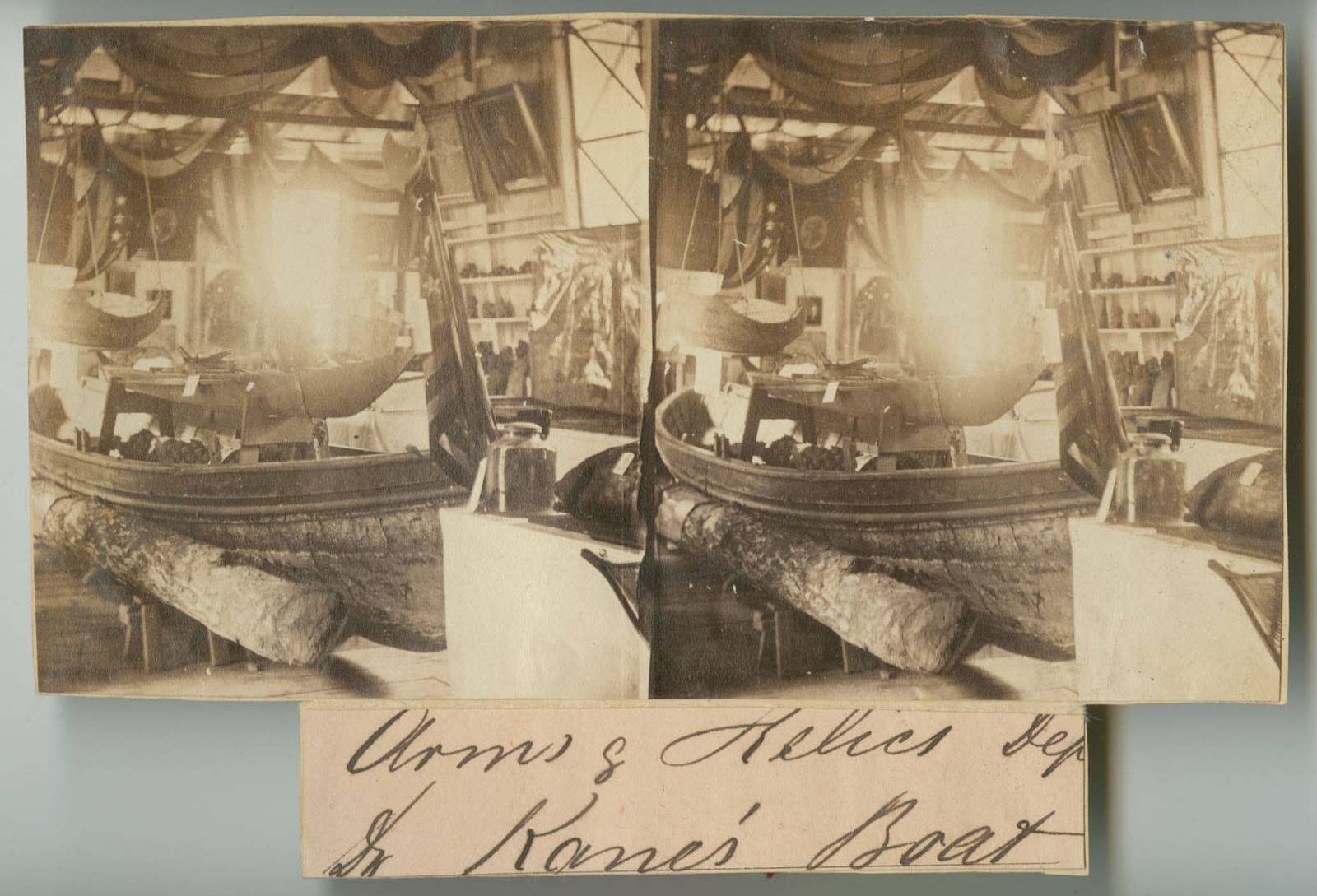
The Fate of Dr. Kane's boat, the "Faith"

In my remarks to those gathered last week beside his tomb to commemorate the career of Dr. Elisha Kent Kane -- whose Arctic career once made him the most famous man in America -- and unveil a new historical marker at the site, I meditated on the fleeting nature of fame. From Kane's second and final northern voyage, as the commander of the Second Grinnell Expedition, I knew of several items that had been brought home, including the figurehead of Kane's ship, the "Advance" -- which, after a stint at the now-defunct Mercantile Library, is now safely enclosed in a glass case at the Kane Lodge in New York City -- and also of Kane's boat, the "Faith." As the lone survivor of the ship's whaleboats -- the others were burnt for fuel -- and the vessel which finally conveyed Kane and his men to safety, one would think that this vessel, like Shackleton's better-known "James Caird" -- would still be extant, and valued. It was, for a time, displayed at Deer Park in Philadelphia (where, exposed to the elements, it may have suffered new indignities), but survived long enough to be displayed at the Great Central or Sanitary Fair of 1864 (see above), as well as twelve years later at the Centennial Exhibition, after which all mention of it seems to have vanished. I often wondered whether it might still be stowed away in some nook or cranny, perhaps parked next to his old sled (which ended up at the Smithsonian)

Just recently, though, I came upon a watercolor in the collections of the Historical Society of Pennsylvania, by the artist David J. Kennedy. It showed the "Faith" almost as she would have looked when new, or if completely restored. An inscription by the artist on the back, alas, showed that this was the result of his skill with the brush, and not of any restorative efforts:
“The Faith at my suggestion was patched up and exhibited at the Centennial Exposition at the south part of the United States Government Building. An evening after the exposition had closed it fell in pieces, a wreck, rotted out."
One wishes that someone had, at the time, secured some small bit -- a fragment of a gunwale, or a plank -- and perhaps someone did, and it will turn up somewhere. But for the "Faith" herself, it seems to have been her destiny to hold herself together just until the Nation's centennial, and then fall to pieces all at once, like the wonderful one-hoss shay of legend.

Thursday, September 1, 2016

This year's Franklin search

Here at Visions of the North, I've been following Parks Canada's search for Franklin's ships almost from the very beginning; while the blog wasn't yet online for the search led by Robert Grenier in 2008, I interviewed him the following November in Greenwich. I even covereed the absence of a search in 2009, and have posted about each year's search thereafter. 2014, of course, was the annus mirabilis -- the year that Franklin's flagship, HMS Erebus, was finally found -- and 2015 followed with the recovery of a fascinating array of artifacts from that vessel, many of which, although still in conservation, have already been displayed to the public. It's fair to say that, every year around this time, anticipation is keenly felt and hopes run high.

This year's search looks to be a modest one, with only a couple of days diving on "Erebus," and perhaps a week or a little more pursuing her sister ship "Terror." Divers plan a site survey of "Erebus" looking at the stability of the wreck and determining if there have been any significant changes; meanwhile, in the Victoria Strait area, it's hoped that a side-scan sonar search of the area following the drift path of ships or débris from the last recorded location of "Terror" might shine some light on its fate. While my own view is similar to that of Dave Woodman -- that the ship is more likely to be found within the horizon line from the Erebus Bay encampment -- one can't entirely rule out the possibility that the "Terror" met its fate further north; as I noted in my last post, the Inuit testimony about that vessel, substantial as it is, doesn't give us a clear, unambiguous location, unlike the wreck at Utjulik, which we now know to have been "Erebus."

The big news this year isn't so much the search itself as it is the development of a carefully-negotiated set of agreements and protocols, followed up by a number of meetings with Inuit communities. Parks Canada, to its credit, is going above and beyond the letter of the Nunavut Land Claims Agreement; while there's an argument to be made that maritime wrecks of foreign naval vessels aren't covered, they are following all the procedures that would be followed if they were. I think this is an important step, and from what I've heard, Inuit in the Kitikmeot region, as well as Nunavummiut generally, are pleased with these steps. In addition to community outreach, there's a clear signal that, from the 16.9 million allocated for the search over the next five years, there will be a significant commitment to what's described as a "multi-purpose infrastructure" including economic opportunities in Inuit communities. In another important development, a "Franklin Interim Advisory Committee" has been established, whose members include the Kitikmeot Inuit Association (co-chair), community representatives from Cambridge Bay and Gjoa Haven, Inuit Heritage Trust, the Government of Nunavut, Nunavut Tourism and Parks Canada.

And it's important that these developments be in place, not only to increase Inuit participation and make the search planning more transparent, but to avoid misunderstanding over the disposition of such relics are are recovered in the future. As I note in the conclusion of the final chapter of my book Finding Franklin,
"[The Franklin search] would more meaningful if it could also contribute something to the fragile northern economy, [and] to the generation of young Inuit across the territory. Our histories, after all, are tangled up together."

Thursday, August 18, 2016

Where to look for HMS "Terror"?

With the discovery by Parks Canada's marine archaeologists of HMS "Erebus" in 2014, the burning question has been the location of her sister ship, HMS "Terror." This year's search by Parks is planned to focus on the Terror, though there will be some new dives on Erebus as well. One might assume that, with one ship located and identified, it might be possible to narrow the range of sites to search for the second vessel, but that's not necessarily the case. In fact, since the Inuit never knew the name of either vessel, it takes some considerable review of the available testimony to sort out which tales refer to which ship; only then can we begin to form a clearer view of the possibilities. And, as was true of the 2014 find, it's mainly but not solely Inuit testimony that we need to consider.

One account that may deserve fresh attention is that given to L.T. Burwash by Enukshakak and Nowya in 1929, describing a cache of crates "northeast of Matty Island," along with wooden planks washed up on the shore, presumably from a wreck "three quarters of a mile off the coast of the island." Since we know that, if indeed this is a Franklin ship, it could only be the Terror, then this testimony offers one line of possibility. Similarly, any other sightings of ships at sites some distance from the known location of Erebus can, if accurate, only be of Terror -- these would include the ship possibly seen by Anderson's men in 1855 somewhere off Ogle Point.

These stories, though, are outliers to the main threads of Inuit tradition, which have the advantage that they begin with two ships, and include eyewitness accounts of one of them sinking. The most dramatic account of this was given to Hall by Kok-lee-arng-nun:
The old man and his wife agreed in saying that the ship on board of which they had often seen Too-loo-ark was overwhelmed with heavy ice in the spring of the year. While the ice was slowly crushing it, the men all worked for their lives in getting out provisions; but, before they could save much, the ice turned the vessel down on its side, crushing the masts and breaking a hole in her bottom and so overwhelming her that she sank at once, and had never been seen again. Several men at work in her could not get out in time, and were carried down with her and drowned.
Apparently, this ship's sinking was visible from on or near shore, and Inuit were present to witness it. Since the Victory Point record indicates both ships were intact when abandoned, and Inuit only learned of the Crozier's landing site (from McClintock's interpreter) in 1859, this event must have taken place after the ships were re-manned. There's good circumstantial evidence that this was the Terror; if we take the "Too-loo-ark" of this story to be Crozier then it would be the ship aboard which the Inuit often saw him, and the line in the "Peglar Papers" about the "Terror Camp" being clear suggests that the survivors from that vessel camped on the land. The likeliest site for this would seem to be Erebus bay, and as Dave Woodman has noted, the "visibility from shore" horizon line enables one to project an area of high probability (you can read his new, detailed account of this here or via my Franklin search archival pages).

At the same time, there are those who still believe that it's more likely that the Terror foundered before reaching that area. It seems significant to them that much of the recovered material from the Erebus Bay site is in fact associated with the Erebus, whereas if the Terror sank near there, more material from that ship might be expected. This was the original plan of the 2014 expedition, which took its name from the Victoria Strait, the goal of which was to locate the wreck or sunken debris from Terror. And now, in 2016, it seems that this is once more the primary search area that's been chosen, though of course it's also possible that ice conditions may limit or prevent a search there, as they did in 2014. It should be remembered that it was only after the disappointment of being unable to reach that year's goal that the Parks Canada team fell back on a further search in the Wilmot and Crampton Bay area -- and that it was that very search that finally revealed the golden sonar shadow of Franklin's flagship.

Saturday, August 6, 2016

Utensils and the Franklin search

Sometimes, the humblest objects of daily use tell a tale more eloquent, more rich and complex, than anything we could gain from written records. Such is certainly the case with the material relics of the Franklin expedition. Setting aside those with greatest seeming significance -- Franklin's Hanoverian badge, the infamous dipping needle, or Des Voeux's shirtsleeve -- some of the most common items recovered have the greatest potential meaning for those attempting to reconstruct the last months of the Franklin expedition. I refer, of course to utensils -- forks, spoons, and the occasional knife -- which were recovered by many early Franklin searchers from Rae to Schwatka -- and which, even today, have not yet been systematically examined for what they can tell.

The utensils, most of them quality silver plate, were initially recognized on account of the family crests on their handles, which showed them to be from the families of officers such as Franklin and Crozier. Franklin's distinctive crest -- a conger eel's head between two sprigs -- was the most commonly found, suggesting that his plate had been first and widely distributed among the sailors; perhaps the most poignant of the crests was that of Fairholme -- a dove with an olive branch and the motto "Spero meliora" -- I hope for better things.

And yet there's more: on the stems and undersides of these same spoons and forks, there are found the scratched initials of other men, most of them ordinary seamen. The only explanation seems to be that, prior to the abandonment of the "Erebus" and "Terror," the silverware of the officers of both ships was distributed to the men for their use. In some cases, as with Franklin's, this was because the officer in question was deceased -- but the principal reason, doubtless, was to preserve the silver plate without burdening any one party with too large a quantity. And, since the silver plate from the officers from each ship was distributed to sailors aboard the same vessel, the discovery of a fork or a spoon -- provided its provenance can be definitely settled -- may give us a very likely indication of the path of the crew of that ship.

The pattern seems suggestive -- for instance, nearly all of the utensils recovered by McClintock at Cape Norton on the eastern side of King William Island were connected with the "Terror" -- there were two Franklin spoons marked "WW" (William Wentzall, seaman) and WG (William Gibson, steward), both of the "Terror," along with a Crozier fork and a teaspoon of Alexander McDonald, assistant surgeon. Only one item -- a Fairholme teaspoon -- was associated with the "Erebus." Now that we know that the "Erebus" was piloted to a point much further south in Wilmott and Crampton Bay, that would seem to explain the paucity of silverware from her officers -- and so, might the frequency of "Terror" forks and spoons then suggest its having sunk nearby? If so, this would certainly fit in with L.T. Burwash's theory that a Franklin ship sank in the vicinity.

When McClintock visited a party of Netsilingmiut near the North Magnetic Pole, which would have been near the next general transit of such a journey, he obtained mostly utensils from the "Erebus," although a lone McDonald fork was among them; this would now seem to suggest that perhaps a party from that vessel passed through this area. But of course, utensils could very well have been obtained through trade with other Inuit. What then, of spoons or forks with a clearer provenance? Alas, even when we have a utensil handed in by someone who claimed to have originally found it, the evidence is very mixed. The famous spoon offered to Schwatka (see above), complete with the Franklin crest and a distinctive mending job where the cracked bowl had been repaired with copper, is one such example; the giver, one Nu-tar-ge-ark, could offer only a clouded account:
He said it was given to him by some of his tribe, and that it had come from one of the boat places, or where skeletons had been found on King William Land or Adelaide Peninsula, he could not remember exactly where. 
(see the "Schwatka" chapter of my Finding Franklin for a fuller account of this spoon).

Since the vast majority of this silverware is now catalogued online, it's a question that offers at least the possibility of an "armchair" solution. Most of them are catalogued at the National Maritime Museum at Greenwich, with a few others -- part of the Lefoy bequest that included Sophia Cracroft's collection -- are now at the Scott Polar Research Institute. Another small collection was retained by Dr. Rae, and later given by him to the University of Edinburgh, these do not seem to have been given detailed analysis (although, judging from the images as they appear in the SCRAN database, they unfortunately seem to have been polished!). 

Monday, July 25, 2016

Whose are the Franklin relics?

There's been a spate of reporting -- much of it plagued with inaccuracies -- about the ownership and disposition of the relics of Sir John Franklin's expedition, specifically those relics which have been brought back from the wreck of HMS "Erebus" by Parks Canada, and those that will (hopefully) be brought back in the future. Some believe that, under the Nunanvut Land Claims Agreement of 1993, the relics ought to belong to the Inuit; others feel they rightfully belong to all Canadians; still others have put forth the (misleading) claim that Britain will get to "cherry pick" those relics they want to keep. Before I offer my own view, it's best to start by clearing up the considerable -- and avoidable -- confusion over the legal status of these relics.

First off: while certainly the Inuit have a strong interest in the disposition and display of these relics -- after all, they're hard evidence of the value of Inuit oral traditions -- they legally belong to Canada. This is because, under international maritime agreements, the contents of any modern military wreck belong to the nation whose ship it was. In the case of HMS "Erebus," that nation is the United Kingdom. However, there exists a very clear memorandum of understanding (MOI) signed by representatives of both the UK and Canada, transferring salvage rights to Canada (with the exception only of any gold that might be found). While yes, it's true that the NLCA assigns ownership of archaelogical finds to Nunavut, that probably doesn't supersede national and international law (though I should emphasize that I'm not a lawyer); though conceiveably the Government of Nunavut could make a legal objection, that would only have the effect -- to my mind very unfortunate -- of delaying the hoped-for public display of these artifacts, which is something of significant value both to both Nunavummiut and other Canadians alike. It's also unfortunate because, as I understand it, agreements were already at least tentatively in place for the HMS "Erebus" historic site to be co-administered by Inuit and Parks Canada, with an interpretive centre in Gjoa Haven in the works. These plans are said to include working "closely with the Kitikmeot Inuit Association to negotiate an Inuit Impact and Benefit Agreement as required under the Nunavut Land Claims Agreement."

Secondly, despite the recent reporting otherwise, the MOI does not give Britain the right to "cherry pick" relics it would like to keep. The exact language of that agreement is in a proviso to the section assigning Canada ownership of "everything recovered from that wreck," which provides that "any recovered artifacts identified by Britain as being of outstanding significance to the Royal Navy will be offered to Britain for display in an appropriate museum." Again, though I'm not a lawyer, the import of the word "offered" seems to be "for display" -- that is, the objects would be loaned for that purpose by Canada. The loan could, conceiveably, be long-term, but the clause doesn't seem to me to obviate the "everything" of the main section. And indeed, there are plans afoot for such a display, one that would first be mounted at the National Maritime Museum in Greenwich, and then shown at the Canadian Museum of History in Ottawa. This is just the sort of co-operative bi-national exhibit that I believe the MOI -- written before "Erebus" was found -- had in mind.

I believe -- I hope -- that everyone involved with this magnificent discovery acknowledges two central facts 1) That HMS "Erebus" might well never have been found were it not for the Inuit oral traditions as to its location; and 2) These relics tell a tale of both British and Canadian history, as well as Inuit history, that very much ought to be told from an international stage. The unfortunate truth is that, even were it decreed that these relics were the sole property of the Inuit, there is no appropriate archive in Nunavut where they could be conserved and displayed. The original Archives of Nunavut, created in 1999 with the establishment of that territory, are stored at the Prince of Wales Northern Heritage Centre in Yellowknife, but that repository long ago reached full capacity. Presently, new items for this archive are going to the Canadian Museum of Nature, where they are, as with the Yellowknife materials, held in trust for the Government of Nunavut and its people.

It's my fervent belief that these extraordinary relics and the story they tell belong to all Canadians, including Inuit -- and, in a symbolic sense, to the nation that launched the Franklin expedition. Co-operation and mutual trust between all parties is essential, and hasty and inaccurate stories about the disposition of the relics do nothing to advance this cause.

Saturday, July 16, 2016

Named after Franklin

By Tabercil - Own work, under license via CC BY-SA 3.0
One measure of the influence of a man might be considered to be how many others were given his name -- that is to say, his namesakes. By that measure, it would seem Sir John Franklin was a significant figure indeed, one whose name a great number of parents in his day and long after chose to bestow upon their offspring. One of those you might least suspect -- the great Canadian comedian John Candy -- was actually given the name John Franklin Candy at birth; the image at left depicts his star in Canada's Walk of Fame. Born in 1950, Candy is actually one of the more recent Franklin namesakes; the name seems to have been at its peak in the mid-to-late 1850's and then again in the 1890's and 1940's. In the account that follows, I should emphasize that I don't actually have any definitive account of the reason for the bestowal of these names, though certainly Franklin's is by far the best known possible source; I've eliminated cases where the name has a family precedent (father or grandfather), along with those who were born too early (prior to Franklin's name becoming well-known around 1818).

Among those to bear the name during the early Franklin search era of the 1850's, we have John Franklin Crowell (1857-1931) an early president of Trinity College (now Duke University). That same year, John Franklin Alexander Strong shared an Arctic destiny with his namesake; born in Canada, Strong went on to be just the second Governor of the Alaska Territory. In 1860, John Franklin Kinney, and leading New York Democrat and jurist, was born, and in 1862 we have John Franklin Miller, a member of Congress from Washington, DC. Moving toward the end of the century, we find John Franklin Enders (1897-1985), a pioneering scientist known as the "Father of American Vaccines."

The early twentieth century brings us my favorite of all, the novelist John Franklin Bardin, who worked in an advertising agency by day and wrote dark psychological thrillers by night; his novel The Deadly Percheron may be one of the most harrowing, yet whimsical novels ever penned (the name comes from the killer's habit of leaving Percheron horses at the scenes of his crimes; the book is the one being read by Bob Hoskins' character in the film Mona Lisa). A decade later we have the painter John Franklin Koenig, who grew up in Seattle near Lake Union, though he spent much of his artistic career in France.

And there may be many more -- the genealogical research site familysearch.org lists tens of thousands of them; even if only a small minority were actually named after our Sir John, it would be a considerable number. We may never know much of the lives of John Franklin Eustace, John Franklin Bainbridge, John Franklin Pollard, or John Franklin Brearly Goodall (this last of whom, like many others, was an Australian) -- but they remain curiously woven together by the thread of Franklin's name.

Sunday, July 3, 2016

Franklin Searcher of the Month: Margaret Bertulli

Makeshift crampons for walking on hard snow and ice; found at NgLj-2 in 1993
As part of my ongoing series on those who have searched for Franklin, I thought I'd take this occasion to speak with Margaret Bertulli, who was one of the first professional archaelogists to do work on the western shores of King William Island in the 1990's. These days, she's retired but far from inactive -- indeed, she'll be serving as one of the resident experts on Crystal Cruise Lines' upcoming Northwest Passage voyage, which will be the first to bring a large-size cruise vessel through this route. I reached her at her home in Winnipeg.


*   *   *   *   *

Tell us, what brought you to the search for Franklin? 

In the early 1990s when I was the Arctic Archaeologist at the Prince of Wales Northern Heritage Centre in Yellowknife, Barry Ranford, a school teacher from southern Ontario and his colleague discovered a site with human remains on their trek down the west coast of King William Island. It was very dramatic as skulls and parts of infracranial skeletons were scattered across the ground surface of a small tidal island in Erebus Bay.  Mr. Ranford had long been a Franklin enthusiast and this find was the first in decades with the potential to reveal more information about the fate of the Franklin Expedition.  Mr. Ranford contacted the Heritage Centre and we organized a project for the following summer to conduct archaeological excavation and physical analysis of the human remains.  Dr. Anne Keenleyside was the physical anthropologist who accompanied this project and analysed the skeletal remains.  As the archaeologist in charge of the project, I prepared all of the logistics and conducted the excavation.  It was particularly interesting for me to hear Mr. Ranford describe how he put himself in the frame of mind of the survivors as he walked along the low-lying terrain of western KWI, imagining himself in their footsteps and looking for Franklin-related items.  He found at least two sites in this way.  I remember flying on a Polar Continental Shelf Project Twin Otter from Resolute Bay to the site on KWI.  Looking out the plane’s window, I marvelled at the myriad lakes and how desolate the terrain seemed.  I began to understand a little about how these British sailors could have felt in this landscape.  ‘Desolate’ is not generally a word I use to describe the Arctic because to my mind it is beautiful and full of wonders but, in this case, I could empathise with men far from home and longing to return.

When you first arrived at the NgLj-2 site, what were your impressions? The bones, of course, have been the subject of much discussion, but I'd be especially interested in your thoughts on some of the other material artifacts --pipe bowls, buckles, glass fragments, buttons, and such. What do you think this site and those near it represent?

It was a sunny mid-afternoon when we arrived.  The Twin Otter blew a tire on landing and Mr. Ranford showed the pilot and co-pilot around the site.  After that the pilots retired to the aircraft to await the arrival of another plane carrying a spare for them.  I was glad to arrive at our destination and know the exact location of the site as Mr. Ranford had not been willing to disclose this information, concerned that others would pre-empt his discovery.  In the midst of unloading our supplies from the Twin Otter, setting up tents and radio contact with Polar Shelf, it was some time until I could walk across the tidal flats from our camp to the small island.

The area is very pretty with valiant little flowers and a huge celestial dome; one could see approaching weather long before it arrived at our camp.

The artifacts that we recovered from surface collection and limited excavation that summer were very fragmented.  They were really only bits of bits of artifacts and yet some provided information about how the men prepared for this journey; for example, the fragments of copper gauze and a partial lens of purple glass indicate that they probably used these materials to make goggles to protect against snow blindness.  (I have never experienced that myself but did over-expose my eyes to the Arctic sun one afternoon on Devon Island and can tell you that it was painful—I wore sunglasses even indoors for the next few days.)  One particularly poignant find consisted of cut shoe heels through which copper tacks have been driven so that the points of the tacks would protrude through the heel and provide the wearer with purchase on the ice and snow.  Any material of value had long since been recruited to new purpose by Inuit who had visited the area.

I know that you've returned several times to the western coast of King William Island, investigating other possible Franklin sites. Do you think it's probable that there might still be undiscovered sites of significance in this area?

I’ve been on field projects on KWI in 1993 for the excavation of NgLj-2 and to Cape Felix in 1995.  I think it is highly probable that there may yet be more sites.  Unless one has been there, it is difficult to appreciate how the terrain effects what one sees on the ground surface.  It is easy to walk within several feet of a find or artifact and not see it as the ground is covered with shattered limestone slabs about the size of dinner plates so that one must be careful with one’s footing.  Many of the objects are small and not highly visible.  The low-lying terrain fosters very poor drainage so that in some years previously dry areas may be water-covered.  Of course, a helicopter would be a useful yet expensive way to conduct survey.

What other sites on land would, in your view, be the most promising for additional archaeological work?

One can return to the same site for multiple years and always find something new or re-interpret evidence and ideas so the area around Erebus Bay would be a likely place to recover further information.  I think that Terror Bay could also be explored systematically.

Do you think it would be worthwhile to revisit Starvation Cove or perhaps the Todd Islets/Booth Point areas?

I certainly think it would be beneficial to revisit Starvation Cove, Booth Point and Todd Islets. etc.  I guess the point I was trying to make was that each area could benefit from multiple searches and searchers  because one sees something different every time and different people notice or perceive in various ways leading to fuller and more detailed explanations or ideas.

In the planned exhibition of Franklin relics in Britain and Canada next year, what would you regard as the most significant, in terms of helping the public understand the significance of the demise of Franklin's expedition.

It seems to me that people have expounded on the significance of the expedition’s demise in poetry, song and scholarly articles for over a century.  What is the significance of a well-outfitted expedition failing spectacularly and mysteriously?  What is the significance for us today?  Perhaps, it is not the artifacts that will help us to understand but exploring the human psyche may provide clues to this fascination.  Having said that, those artifacts which are concerned with the minutiae of daily life and the operation of a nineteenth-century sailing vessel would be interesting to the general public.

Is there any artifact in particular that spoke to you?

The artifacts that spoke most to me were the ones that individuals would have worn and used, like the purple lens for snow goggles and the boot heel with the tacks.  Also, the illuminators are interesting, such as the ones that were recovered from the Erebus.