Wednesday, May 1, 2013

Brains for Dinner

Those who have, over the years, expressed strong skepticism over the possibility of members of the Franklin expedition indulging in cannibalism take note: here is evidence, once more, of the fact that in the most desperate mad horrific of times, English people would east English people. It's a testimony to the ability of forensic science to re-construct and understand the acts of people who, on the edge of their own annihilation, reached for the "last resource" -- the bodies of their own dead. One should emphasize that, in both the case of Franklin's men and the Jamestown settlers, we have no indication that anyone actively sought to kill anyone else for the purpose of eating them. But, once dead, it's clear that human remains, and the promise of survival, however slender, that they offered, were irresistible to their comrades in the depths of despair and hunger.

Cut marks are again the key clue. In the skull of the teenage, upper-class 14-15-year-old dubbed "Jane" by those who studied the remains, the evidence is grisly. Clearly, whoever was seeking nutriment from this skull did not know how to go about doing so; there were three axe-blows on the side of the head, and three more severe ones at the back on the cranium, before the skull was actually split; this was followed by the use of a crowbar to break the shattered skull open. There are also a number of lighter cut-marks, probably produced by a knife rather than an axe, which indicate prior or further attempts to deflesh the skull; it is these cut-marks which are most similar to those seen on Franklin remains. Collectively, they tell of the attempts of a person unacquainted with butchery to butcher a fellow human being.

Brains of other animals were eaten by English folk of the Jamestown era -- indeed, their overall diet back home would have had its share of organ meats, intestines, and other animal parts far less commonly eaten by humans today. So their desperation had, in a sense, a goal perhaps less grotesque to the Jamestown settlers than to us today.

There are a number of resources and news stories online today about this finding -- the Smithsonian's site has the best, including an article in Smithsonian Magazine, as well as this video with the lead investigators, which also shows the reconstructed head of "Jane." From the content of her teeth, she seems to have enjoyed a higher-protein diet, which makes it more likely that she was one of the upper classes and not a servant.

No one likes to imagine cannibalism.  But no one should think that, in the worst of circumstances, people of any culture or nationality are immune to it.

Monday, April 22, 2013

Arctic Visions in New Bedford

This Friday, April 26th, at the New Bedford Whaling Museum, a new exhibition of Arctic art and imagery unlike any other has its opening day. Entitled Arctic Visions: Away Then Floats the Ice-Island, it documents not only the views of Arctic scenes painted by William Bradford, but the magnificent photographs taken by the photographers George P. Critcherson and John Dunmore, who accompanied Bradford on his Arctic voyages, most importantly that aboard the "Panther" in 1869, from which the view shown above was taken. Working in challenging circumstances taking wet-plate photographs on glass and using a shipboard darkroom, these two photographers worked visual miracles. On their return, their negatives were used for a number of purposes: first, as part of a series of magic lantern lectures, narrated by Bradford and others, second, as the basis for many of Bradford's paintings and a viewbook for possible new commissions (Queen Victoria chose one that way), and finally as albumen prints, most notably used as illustrations for the magisterial, "imperial folio" volume The Arctic Regions, arguably the first, finest -- and rarest -- volumes about the Arctic ever to be illustrated with photographs.

This new exhibit offers many different ways to see all three of these uses of these pioneering photographs. An original copy of The Arctic Regions will be on display, along with touch-screen version that museum-goers can page through. Working with Boston fine-art publisher David R. Godine, the museum has republished this remarkable volume; although the format is smaller (relatively speaking!) most of the photographs are reproduced at larger than their original size. Copies of this book, for which I've written a new introduction, will be available at the Museum.

Nearby, one can view some of the original glass plate negatives, as well as albumen prints, along with several Bradford canvasses based on these same views, alongside his magisterial "Sealers Crushed by Icebergs." The lantern shows -- which eventually evolved into a series known as "The Bradford Recitals," have been be re-created with their original narration. And, to set these images in their context, there will be a rich array of polar artifacts, Inuit clothing and boat models, and even a desk -- the companion of that in the Oval Office -- made from the timbers of the Arctic search ship HMS "Resolute," and given by Queen Victoria to Henry Grinnell, sponsor of two key Arctic expeditions in the 1850's.

The concurrent exhibition "Following the Panther: Arctic Photographs of Rena Bass-Forman," showcases the work of contemporary artist Rena Bass-Forman who, inspired by Bradford's voyage, retraced Bradford's footsteps in the land of ice and stone, photographing many of these same sites as the now appear.

If you can, try to make it to the grand opening this Friday at 5 p.m. -- to mark the occasion, there will be an Arctic lantern lecture by the incomparable Terry Borton of the American Magic Lantern Theater -- and of course there will be the exhibit itself, one not to be missed!

Tuesday, February 26, 2013

Franklin and Scurvy

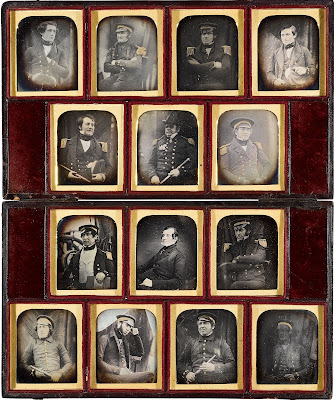
When I went up to Nunavut to participate in the ITN/NOVA program "Arctic Passage," the only other specialist the producers brought was a physician who was an expert in scurvy. And this of course made perfect sense -- after all, wasn't scurvy one of the unholy trinity (the others being lead-poisoning and cannibalism) that everyone assumed played at least some role in the demise of Franklin's men?

Well, now comes a team of osteoarchaeologists with a paper that takes a skeptical look at this assumption. The bones examined included the Greenwich skeleton (previously thought to be that of Le Vesconte) along with small numbers of bones found at Erebus Bay and Booth Point by Owen Beattie. The largest set of bones studied in modern times, those brought back from Ng-Lj-2 by Anne Keenleyside, have since been re-interred and were thus not available for direct study; here, they just examined images and data from the previous study.

I'm no specialist, but the basic gist of what they were looking for is fairly straightforward: The presence  of damage or lesions on the bone suggestive either of haemorrhage or of bone that healed imperfectly or not at all after injury. Since scurvy inhibits bone growth and repair, either one would be evidence of its presence, while the absence of such damage, or the presence of bone that had properly healed, would be evidence of the absence of the disease.

Their overall conclusion? They found  "little evidence of bony lesions consistent with evidence of the disease" and therefore suggest that "factors other than scurvy may have been the main causes of morbidity and mortality." And yet, although I have learned from friends such as William Battersby that there's a great deal to be learned by questioning the received wisdom and assumptions of past histories, I believe that this particular paper is significantly flawed, and casts very little reliable light on the question it sets out to answer.

The problems are twofold: 1) The authors rely on a variety of very uneven secondary sources as to problems with scurvy on other Arctic voyages, cherry-picking even from among these, and thus paint a deceptively optimistic picture of the success of the usual Naval regime of lemon juice; and 2) The authors do not account for the extremely small size of their sample, nor for the very limited range of sites from which the bones were recovered.

As to the first, they completely mangle the Arctic experience of Sir John Ross, mistakenly claiming that he spent four winters in the Arctic on his 1818 voyage, and treating his 1829 voyage as though it were a second one of equal duration. They are also do not mention, or are unaware, that Ross on his multi-year sojourn of 1829 received large quantities fish and fresh meat for two of those winters from his Netsilingmiut neighbors, which is almost certainly the reason for the low incidence of scurvy. They also do not look closely at multi-year expeditions, mentioning McClure and mentioning as if in passing the deaths of three of his men; casualties from other Franklin search expeditions are not mentioned at all.

Secondly, as to the sample size: they looked only at 409 bones in all. There were 129 men on the Franklin expedition, with 206 bones each -- thus 26,574 bones among them. -- so 409 bones is only 1.5% of the total. Only 105 of these bones were physically examined, less that four-tenths of one percent. All of these also come from a couple of sites on the southern coast of King William Island.

The final flaw, it seems to me, is that the writers acknowledge that it is possible that an individual could indeed be suffering from scurvy's ravages, but not show evidence of it in his bones. This makes it really impossible to extrapolate from this tiny sample anything about the prevalence of scurvy among Franklin's men. The matter surely could be further studied, but I believe that the preponderance of evidence from actual Arctic voyages of this period is that, at least in all expeditions lasting more than one winter -- with the exception of those where fresh meat was available in large quantities (Ross 1829) -- scurvy was a widespread and persisent cause of debility and death.

Sunday, January 27, 2013

Franklin Fictions (repost)

From the first moment his ships were missed, the lost expedition of Sir John Franklin has fired the imagination of poets, dramatists, and (especially) novelists. At last count there were no fewer than twenty-four novels, ranging from Jules Verne’s The Adventures of Captain Hatteras in 1864 to Dominique Fortier's On the Proper Use of Stars, which just appeared in English translation last month. Essays by writers as diverse as George Eliot, Joseph Conrad, and Margaret Atwood, have tackled the Franklin fascination, and a full collection of all the historical studies, monographs, and illustrated books on the expedition would easily fill a room (my own collection, which is very far from complete, already fills one). There have also been at least five full-length documentary films, although not yet a feature film of a purely dramatic sort (although I know of at least three screenplays for proposed films). For this entry, I’ll focus on the fictions – and the differing ways they draw upon the basic outlines of the Franklin story.

Franklin himself has fared rather unevenly in this body of work; he has been portrayed, variously, a sort of saint of “slowness” (Nadolny), a neckless nabob fleeing from a domineering wife (Flanagan), a dim-witted leader known to the Indians as “Thick English,” a snowbound abbot of a shipload of polar monks (MacEwen), and the first victim of a bloodthirsty Wendigo (Simmons). To some, he was a hero – but to some (to paraphrase Johnny Cash) his score was ‘zero’ (or perhaps one should say, sub-zero).

Franklin’s officers, too, have proven attractive subjects for fiction; Fitzjames has most frequently been singled out, as in John Wilson’s North With Franklin: The Journals of James Fitzjames, and Crozier has proven an equally attractive figure, bringing with him as he did the shadow of a failed romance with Franklin’s niece Sophy Cracroft. At the same time, some of the poetry and fiction deliberately takes a different tack, as with Rudy Wiebe’s A Discovery of Strangers, which is told largely from the view of the Dene peoples who witnessed Franklin’s first land expedition. Time-travel stories, in which characters from the present are transported to Franklin’s ships, have served as the premise for books as diverse as John Wilson’s young-adult novel Across Frozen Seas and William T. Vollman’s postmodern epic, The Rifles. Those who have searched for Franklin have sometimes ended up with their own novels, as do Charles Francis Hall and his Inuit guides in Steven Heighton’s Afterlands. Polar potboilers such as Dan Simmons’ Terror and Elizabeth MacGregor’s The Ice Child round out the list.

So what is it about Franklin that appeals to such a wide array of authors? Was it his strange and tragic loss, along with two great ships and 128 men? Was it the abundant confidence and hubris his officers expressed as they sailed to their doom? Or was it the surreal setting of the endless fields of ice and snow, hundreds of miles from the nearest outposts of so-called civilization, that struck a chord in the imagination. All of the above, I would say.

The first Franklin “fiction” – if the term applies here – was a fantastical narrative which appeared in 1851 under the capacious title, The extraordinary and all-absorbing journal of Wm. N. Seldon one of a party of three men who belonged to the exploring expedition of Sir John Franklin, and who left the ship Terror, frozen up in ice, in the Arctic ocean, on the 10th day of June, 1850 ... together with an account of the discovery of new and beautiful country, inhabited by a strange race of people ... As had Edgar Allan Poe with his Arthur Gordon Pym, Seldon deliberately evoked all the language and apparatus of an actual sea-story, while retaining a wry and winking eye to the gullibility of his audience; the book was prefaced with a “Life of Sir John Franklin,” and sprinkled with lurid illustrations of men wrestling with ice, polar bears, and each other. Ultimately, alas, it was a fairly conventional piece of frozen melodrama, written to cash in quickly on the current fascination with Franklin’s fate – and of this species, it would not be the last.

Our next candidate is a work by that master of the fantastic, Jules Verne. Those familiar with his other “extraordinary voyages” – Journey to the Center of the Earth and 20,000 Leagues Under the Sea – may be forgiven if they’ve never heard of this work, which appeared under various titles including The Field of Ice, The English at the Pole, and The Voyages of Captain Hatteras. The book had been out of print until a new translation by William Butcher was published by Oxford University Press in 2005. And yet despite its lengthy hiatus, the book reads as well as Verne’s better-known classics, and includes many of the same elements – a half-crazed captain, a mad quest to some unobtainable goal, and a mixture of known and imaginary technological wonders – as do they. The “Captain Hatteras” of the title does not himself encounter Franklin or his men, but he retraces their steps with reverence, making the same pilgrimages to King William Island and Beechey Island that, a few decades later, Roald Amundsen would make in fact. Verne’s conclusion, however, owes little to Franklin or to any other history, save for the old chimera of the “Open Polar Sea.” Verne’s sea is open because it has at its center an active volcano – one can imagine the rest.

From Verne’s novel – which first appeared in English in 1865 – to the next is a gap of nearly a hundred years. And yet it is not entirely without surprise that a descendent of James Fenimore Cooper – he whose books Mark Twain derided as the “broken twig series” – who brought this subject to the fore. With Island of the Lost (1961), Paul Fenimore Cooper laid out the basic elements which would feature in many subsequent fictions: the desolate island, the last march of the starving men, and color commentary on the faded glory and misplaced confidence of the men who sailed so bravely into an icy wilderness. The book has been out of print for some years, although a used copy may be found with an ease that suggests it sold reasonably well.

Four years later, the Australian novelist Nancy Cato entered the field with her book North-West by South. The particular importance of Franklin to Australians is hardly coincidental; as a crewmember on Matthew Filnders’ first circumnavigation of the continent, as well as one of the early governors of Tasmania, Franklin looms nearly as large in the history of Australia as he does in that of Britain or Canada. A prominent member of the “Jindyworobak” movement which sought to promote Australia’s indigenous cultures and histories, Cato deliberately chose subjects for her fictions which evoked the southern continent’s complex histories. Her portrait of Franklin is neither heroic nor anti-heroic, but rather iconic; he ends up representing all the crooked histories of his several pasts, even as his crew inters him in an immense tomb of translucent ice in the midst of the Victoria Straits.

Cato’s was the last word on Franklin in fiction for nearly a decade, until Caroline Tapley’s 1974 young adult novel John Came Down the Backstay. Just as would John Wilson’s YA novelAcross Frozen Seas twenty years later, Tapley focused on one of the cabin “boys” aboard the Erebus and Terror, and the natural fears such a lad would have on embarking on such a perilous voyage. The perspective of a young person makes for compelling storytelling, and yet is not quite consistent with the facts, since all four of the “boys” entered into the muster rolls for Franklin’s ships were at least twenty-one years of age upon sailing.

Perhaps the most daring, resonant, and influential of all Franklin fictions, Sten Nadolny’s Die Entdeckung der Langsamkeit, appeared in German in 1983. Under the title “The Discovery of Slowness,” a brilliant English translation by Ralph Freedman appeared in 1987, and for the first time British and American readers could experience a book which, among other things, launched a televsion series, an opera, and a business philosophy whose seminars dominated the executive suites of German corporations throughout the 1980’s. The keu concept here was “langsamkeit” – slowness – a word whose previous associations had been with mental retardation. Nadolny imagines Franklin as a “slow” child, but sees this not as an impairment but a brilliant gift. The same boy who stood by the schoolhouse wall, unable to catch a thrown ball because he always reached for it after he arrived, found his perfect career in the ice, in a region of the world where being “slow” was just what was called for. Nadolny's novel is notable for the way it combines the carefully-researched actual life of Franklin with the strange conceit of Franklin's "slowness" in such a way that, fanciful though it is, one at times feels as though one is reading his true life story -- or even a truer one.

A lively sense of humor and historical irony were melded in the next Franklin-flavored yarn, Canadian author Mordecai Richler’s sprawling and inventive Solomon Gursky Was Here(1990). In Richler’s playful animadversion on all that has come before, one of the frozen bodies of Franklin’s men excavated by archaeologists turns out to have been given an Orthodox Jewish burial. In the ensuing ruckus, the arrival by sledge of a mysterious man named “Toolooah” (a westernized spelling of the name given Franklin by the Inuit) in the outlands of northern Ontario passes almost without notice – until someone realizes who he might actually be. Although both characters eventually are absorbed within the crazy quilt of the Gursky family, the Franklin connection brings a distinctively Canadian twist to the tale; Richler admitted having been inspired in part by the exhumations of the graves on Beechey Island by Owen Beattie.

The year 1994 saw two ambitious new Franklin fictions: Rudy Wiebe’s A Discovery of Strangers, a provocative historical novel based on Franklin’s first land expedition of 1819-21, and William T. Vollmann’s postmodern pastiche, The Rifles. Wiebe’s book takes a new tactic in having almost the entire tale told from the view of the indigenous peoples and animals of northern Canada; his portrayals of Keshkerrah and Greenstockings are particularly poignant. Wiebe did extensive research on the Tetsot’ine people of the Dene confederation, a group with which his own ancestors, early Mennonite settlers in the area, had enjoyed friendly relations. He was criticized in some quarters for romanticizing his First Nation narrators, and demeaning Franklin, who is known by his Dene nickname “Thick English” throughout the novel. And the same time, the less-famous members of Franklin’s party, particularly midshipman Hood and ordinary seaman Robert Hepburn are sympathetically recalled, and Hepburn takes a turn as the novel’s central narrator.

Vollmann’s The Rifles, published as the sixth of his “Seven Dreams” novels which cover different historical aspects of the colonization of the Americas, is perhaps the most unromantic of all Franklin fictions. The book’s main narrator, like all of Vollmann’s antiheroes loosely based on himself, is a northern vagabond with an Inuk girlfriend, Reepah. The novel hints that they are the reincarnations of Sir John and Lady Jane Franklin, though if true, this must mean that there must have been a considerable karmic debt to be paid off, as these new lives are fraught with poverty, bad teeth, and a profound aimlessness of purpose. Woven in are small sections which halfheartedly re-create the events of the Franklin expedition, as well as a somewhat narcissistic postscript describing Vollmann’s self-arranged sojourn at an abandoned military base on Ellesmere Island. The overall effect is, for me, far from satisfactory, though sprinkled throughout are the usual Vollmann moments of scattershot genius.

The last few years of the twentieth century witnessed several new fictions with elements of the Franklin disaster at or near their center, among them Andrea Barrett’s The Voyage of the Narwhal, Brian Hopkins’s Cold at Heart, and John Wilson’s North With Franklin: The Journals of James Fitzjames. For my purposes, Wilson’s is the most intriguing of these, since it attempts something hitherto untried – the extension of an existing historical document. Fitzjames’s last letters home to his sister, posted from Greenland in 1845, were published in part in the 1850’s, and Wilson tracked down the originals. Together, the form a sort of diary, and Wilson imagines in rich and evocative detail how that diary might have been continued, in letters Fitzjames never lived to post. A beautifully written and produced book, it is still well-known in Canada, though less so here in the US; it’s a volume worth tracking down.

The next great moment in Franklin-related fiction is drawn from the lives of those who searched for him in vain. In his 2006 novel Afterlands, Steven Heighton, with what Kenn Harper has called “powerful descriptive talent,” re-imagines the experience of the crew of C.F. Hall’s ship the “Polaris” after Hall’s death and the stranding of much of her crew on a southward-drifting icefloe. Drawing from the recollections of George Tyson, the party’s nominal leader, and adding in elements from the lives of Hall’s Inuit companions Tookoolito, Ebierbing, and their daughter Panik, Hieghton manages to be both lyrical and clear-headed in his paean to human folly and human endurance, and does so in a historical novel whose factual backgrounds he meticulously researched.

From Heighton’s heights, we descend quickly into the world of Dan Simmons, known for writing historical potboilers in which everything – not excluding kitchen sinks, officers gone mad, and cannibalistic Wendigos scratching at the door – is tossed in for maximum dramatic effect. His Terror (2007) may be both the biggest and the best-selling of Franklin-inspired fiction, and has clearly brought a great deal of pleasure to his devoted fans, despite historical inaccuracies and the heaping of the impossible on top of the improbable. The Wendigo – a legendary spirit of the Canadian north whose bite confers an appetite for human flesh – is of course perfectly fitted to the Franklin expedition, evoking the Inuit testimony given to John Rae and the cut-marks found on the bones of his men, so although it’s highly fantastical, it’s not entirely without historical antecedent.

Last year, with Wanting, Richard Flanagan returned to a chapter in Franklin’s life largely ignored in fiction – his time as the Governor of Van Diemen’s Land, now Tasmania. Flanagan, a Tasmanian writer with a long resumé, is particularly interested in Mathinna, an aboriginal girl adopted by Sir John and Lady Jane. For a time, this young girl was lavished with attention, given a room in Government House and sent to a private school. On the Franklins’ departure, however, she was essentially abandoned, and returned to the poverty and outcast status which were the natives’ allotment in those times. Flanagan interweaves the Tasmanian story with that of Charles Dickens, always a fervent follower of Franklin and Arctic exploration. In one of those historical coincidences which, on examination, seems anything but accidental, Dickens has at the same time just lost his daughter and become estranged from his wife. In an endeavor to dramatize the Franklin tragedy, and raise funds for the newly-widowed wife of his old friend Douglas Jerrold, Dickens and Wilkie Collins wrote and staged The Frozen Deep, a play about lost love and lost explorers which was the toast of London. In assembling a cast for a Manchester performance, Dickens cast Ellen Ternan, a young professional actress who would soon become his – possibly platonic, possibly not – companion for the rest of his life.

Like Wiebe and Heighton, Flanagan’s story is marked by lyrical nuances and judicious interweaving of historical research, both of which are also hallmarks of the newest Franklin fiction, Dominque Fortier's novel, On the Proper Use of Stars. Fortier juxtaposes a wide variety of sources -- ship-board plays, historical documents, recipes, and even an excerpt from Eleanor Porden's poetry -- with a series of finely wrought epiphanies in which, like ghosts in an icy mirror, we see flashes of Crozier, Fitzjames, Lady Franklin, and Sophia Cracroft. It's an impressive tour de force, and in many ways the most all-encompassing of Franklin fictions -- but it will surely not be the last.

[Editor's note: this is a revised and updated version of an earlier post on this blog]

Monday, January 21, 2013

Early Arctic Films Lecture Jan. 25

If you're in the greater Boston area this Friday, why not join the members of the New England branch of the Explorer's Club and come to my talk about early (pre-1922) Arctic films? It's open to the public, and the cost is only $10 -- and the weather outside will be providing a perfect scenic accompaniment, with temperatures in the single digits and plenty of snow.

Everyone has seen -- or at least knows of, Robert Flaherty's Nanook of the North. It's often thought that this film came, as it were, out of the blue, and that nothing before it had come close to portraying  "life in the actual Arctic" (this was Nanook's tagline). But in fact a great variety of films, both factual and fictional, catered to public interest in the regions of eternal frost -- with more than 20 documentaries and expedition films, as well as hundreds of dramatic ones.  In fact, up through 1920, there were as many films set in the frozen North as in the wild West, and if things had worked out a little differently, we might still be watching "Northerns" today instead of "Westerns." The ingredients, of course, were very similar: replace the black-hatted bad guy with a cheating claim-jumping womanizer, replace the town sheriff with a chisel-chinned mountie, and replace horseback chases with dog-team ones, and you've got the basic idea. Many great directors, among them Rollin Sturgeon and Cecil B. DeMille, made "Northerns" back in the day, and though only a few survive today, we have some film stills, scripts, posters, and other ephemera that enable us to know a great deal about them. There were even some very sensitive ethnographic and native films, including 1910's "The Way of the Eskimo" from Selig Polyscope -- the first Inuit-written film to include an all-Inuit cast, nearly a century before Atanarjuat.

My talk, "Heroes and Villains of the Frozen North," will take place on Friday, January 25th, at 8 p.m. (preceded by a social hour that starts at 7) at the Doubletree Guest Suites Hotel, 400 Soldiers Field Road, Boston.  I'll be presenting some hitherto-unseen theatrical stills, along with brief clips from several of the surviving films.

Hope to see you there!

Thursday, December 20, 2012

Arctic Newspapers IV: The Discovery News

When it comes to newspapers printed with moveable type on board Arctic vessels, the least well-known of all is surely The Discovery News, which was published during George Strong Nares's 1875-1876 expedition aboard "Discovery" and "Alert." Printed in two columns on broad quarto-sized sheets, it fully answered to the word "newspaper," differing chiefly by its lack of advertisements and its (necessarily) limited circulation. It was launched with high hopes, as described in the diary of Matthew Miller, Asstant Engineer: "October 15, 1875: The Editor's Box for contributions to the newspaper was fixed upon today, outside of the Naturalist's cabin [Henry Chichester Hart], who has been elected Editor thereof." In November, Miller noted with satisfaction that "Our paper that I have casually mentioned has, by dint of perseverance on the part of the Editor and Printer, been brought out in the form of 2 sheets of closely printed matter of interest to those on board." The copy shown here, from a private collection, is dated Nov. 27, 1875. It mentions an earlier issue published on Nov. 19, and notes that the printer was Benjamin Wyatt. Exactly how many issues were printed may never be known; it's not mentioned again in Miller's diary, and there's no reference to it in Nares's published narrative. It's a shame, since in terms of quality of printing, it's among the finest and most ambitious of all Arctic newspapers.

Wednesday, December 12, 2012

Pigeons and Hectographs

A few weeks ago, news broke of a WWII-era carrier pigeon, whose bones were recently found in a chimney in Surrey. And, more remarkably, attached to one of the deceased bird's legs was a small red cylinder which still contained its original encrypted message! There was a good deal of excitement, and the hope was widely expressed that the message could be decrypted, until it turned out -- according, at least to the GCHQ, the UK government's agency for such things, that the message could not be decrypted, since it apparently had made use of a "one time pad," a form of encryption which, assuming its key is truly random and is only used once, is impossible to break.

It may well be that the message itself will never be known, but, thanks to Nick Pelling and followers at his Cipher Mysteries blog, it turns out one can still learn a good deal about it. The message was signed, after all, by one "W. Stot Sjt" -- the "j" in "Serjeant" makes him a British Army NCO, as the name of that rank was spelt with a "g" in other branches of service -- so Pelling and company tracked him down and identified him as Lance Serjeant William Stout.  Stout, who died of wounds suffered on D-Day and was buried in France, and had a brief but spectacular moment of service in that campaign, apparently managing almost single-handedly to disable several German gun emplacements that lay between his unit's tanks and their goal of Caen. If sent by him, then, the message must have been dispatched on D-Day itself, and may well have consisted of a request for aerial bombardment of certain targets related to this operation, and (possibly, but I think less likely) a note that Stout had been gravely wounded. I would guess that the message was more likely sent prior to Stout's heroic actions, but unless it's eventually deciphered we may never know. Pelling also points out that that the pencilled addendum -- "lib. 1625" -- must have been made by a French speaker, since lib. was almost certainly short for "libéré" -- set free, the time of the pigeon's release for the homeward flight.

And that was when I noticed something odd, something that reminded me of a recent post of mine here about the Greely expedition's "Arctic Moon" newspaper: why were the cipher text, the Serjeant's signature, and the "Time of origin" filled out in blue, while the pigeon's name and number and time of release were written in pencil by a Frenchman?  The blue could, I suppose, have been a ball-point pen (a luxury item hard to obtain in wartime) or, perhaps the original message was, in fact, a hectograph. The pencil-weilding Frenchman indicated that there were two copies; how better to make them quickly than to use a hectograph?  The Serjeant would, with a pre-supplied form, have written the ciphertext master; this would have been taken to the officer in charge of actually dispatching the birds.  He would then have used it to make two hectographic copies, adding the details on each bird to both copies just prior to their release, and then destroying the original.  But were hectographs used at this time for this purpose? Yes indeed, according to this page, which details the work of a young woman, Pauline Gorman, who served at the Allied Forces headquarters in North Africa:
[Gorman] also operated a hectograph machine, a printing process which involved the transfer of an original, prepared with special inks, to a pan of gelatin or a gelatin pad pulled tight on a metal frame. Hectography, which required limited technology — and left few traces behind — could be used in clandestine operations.
The traces left by this process are apparent on the image of the original shown above: at the sixth line of cipher text, the bottom and part of the middle of the last two five-letter groups is oddly darker than the surrounding text, in a way that does not seem to correspond with likely variations in the pressure of a pen.  There's also some unusual touch-up at the left of the line above in the group "UAOTA." This could have been made with a hectograph pencil, the same as used for the original master copy, if (as may have happened) the duplication left these letters indistinct.

The use of the hectograph explains why a message encrypted by a British Army NCO would have been sent and marked by a French soldier -- the Frenchman was at a different location, where the birds were kept, and was using a hectograph to make copies, a good idea given that a single message would have had a far lesser chance of reaching its destination.