Wednesday, April 25, 2012

Petition for Ancanthe

IN the spirit of Lady Franklin's Appeal to Lord Palmerston, I've just done something I've never tried before -- launch a petition.

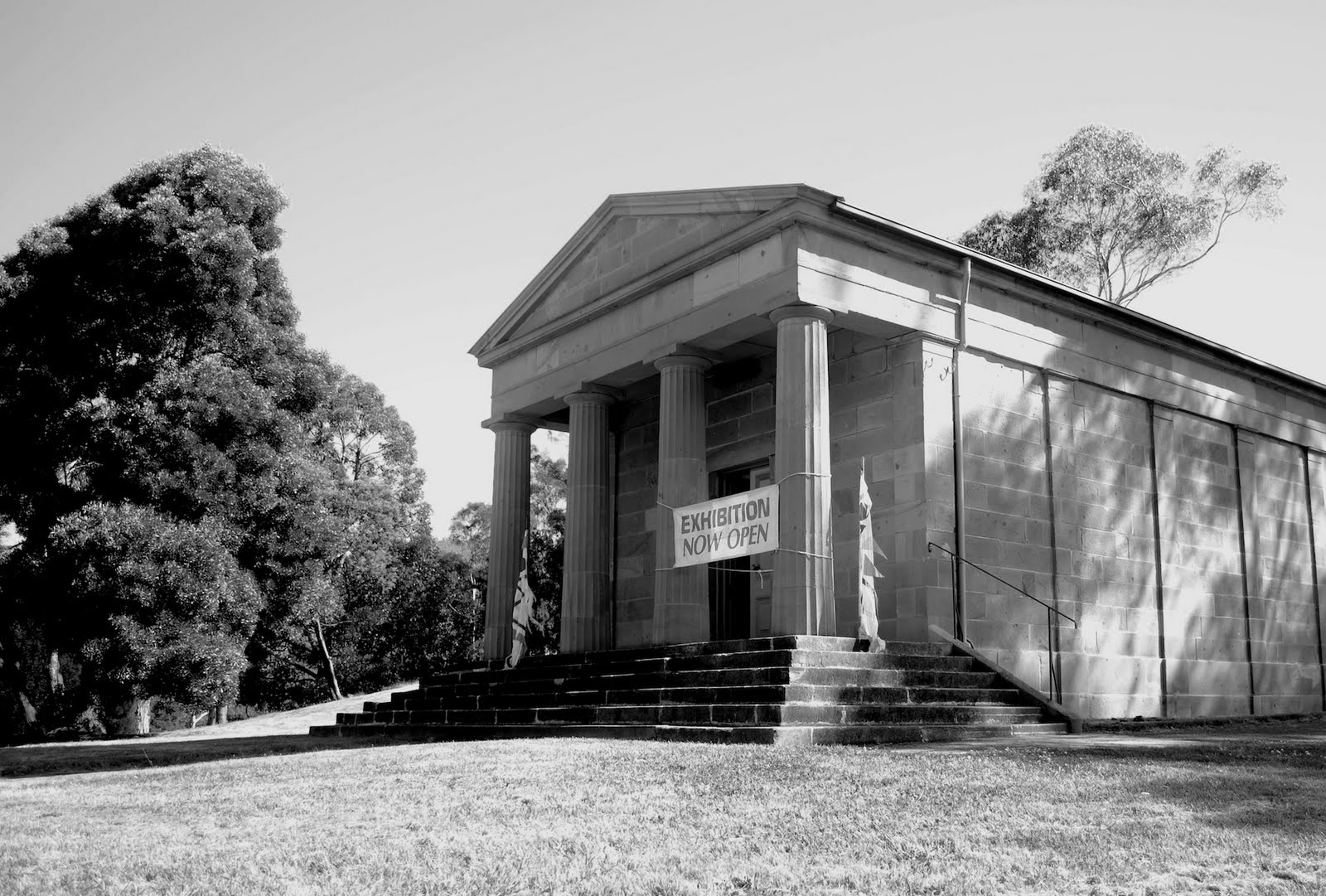
The background is this: Near Hobart in Tasmania, the original Greek-style temple dedicated by Lady Franklin as the centerpiece of botanical garden and museum she named Ancanthe still stands.  Not surprisingly, there has been a fair amount of incursion over the years, with some of the original land now occupied by homes.  Recently, there was a proposal brought to Hobart City Council for a new subdivision which would much further encroach upon the area, and destroy much of its character,  A group of citizens fought back, and are making a counter-proposal that Hobart acquire much of this same area as public lands, and establish there a) A botanical garden, a project not quite realized in Lady Franklin's time, and neglected since; b) A restored museum and grounds, with a "Franklin trail"; and c) an 'international centre of excellence.'

The city council may be persuaded to back the plan, but first they are asking for evidence that the site is one of internationally-recognized historical and cultural significance.  This is something beyond the quick reach of the citizens of Hobart who support this plan, so I've volunteered to enlist all the "Franklinites" I know in its support.

You can read more about the situation on the Saving Ancanthe Facebook page here.


And, if you choose to sign the petition, it's here.


Lastly, if you know of others, whose names I have perhaps neglected to include here, who could lend their heft to the affair, I'd be grateful if you could forward this request.

I hope you'll decide to join me in this effort to preserve a small patch of Franklin history in Tasmania.

Friday, April 13, 2012

Only Known Photo of Lady Jane Franklin

A few years ago -- in May of 2008, to be precise -- I was in Philadelphia along with many Arctic historians and writers for the "North by Degree" conference hosted by the Academy of Natural Sciences and the American Philosophical Society. By good fortune, I found myself at the same bed-and-breakfast as my good friends Huw Lewis-Jones and Kari Herbert, and so we had ample time before and after each batch of conference sessions to talk about our shared passion for all things Polar.  Kari was there to give a talk about some of the remarkable parallels between her mother Lady Marie Herbert's experiences and those of Josephine Peary, and after the conference was off on a research trip to see some Peary materials in Maine. This was all in preparation for her work, Polar Wives, which has now come to fruition, and which traces the careers of many of the women who supported their husbands' Arctic and Antarctic endeavors, whether from home or from a tent pitched in the midst of a howling gale on a rocky beach in Greenland.

Lady Jane Franklin was to be, and is, one of the subjects of Kari's book, and one afternoon in Philadelphia, she mused aloud that there must be, somewhere in some archive, a photograph of her -- why had none ever come to light?  I took this as a personal challenge, and set myself to find one; it was only many months later, by the good chance of putting the right keywords into the right database, that I found just such a photograph at George Eastman House, which has one of the best collections of nineteenth-century (and later) photos of any institution in the world.  It was, like the famous "purloined letter" in the Poe story, hidden in plain sight -- in the center of the frame in one of the stereoviews of Yosemite taken by Carleton E. Watkins, and commercially reproduced by him and succeeding stereoview publishers.  Doubtless there are hundreds of copies -- one of them has recently been scanned and uploaded to the Wikipedia -- but no one had really realized the rarity of the image itself. George Eastman house, happily, has Watkins's original glass plate negatives for his Yosemite views, which can be enlarged much more than the printed cards, and here we can finally see Lady Franklin -- and Sophia Cracroft -- in a camera's eye.

Lady Franklin has a most curious expression -- she seems to be positively beaming good cheer -- but is wearing some sort of Victorian-era hood or wimple that -- for me at least -- brings to mind Sally Field as the Flying Nun.  Traveling costumes for women from this period were odd affairs, to be sure, but Lady F. seems to be sporting one of the odder ones.  Between Jane and Sophia there is the somewhat blurred or  obscured visage of one of their guides, and then we see Sophia's face, everything that Jane's is not -- sober, severe almost, looking directly into the camera.  A few feet further we see two more guides, one of whom is apparently picking his teeth with a twig -- seated at the foot of a tree, the bark of which has been cut with an axe, possibly as a sort of blaze for the trail.  Yosemite, in the 1860's, was a fairly rugged destination, and for Jane and Sophia -- who rarely traveled without some sort of entourage -- this was roughing it.

The larger frame shows two other figures, a man who is seeking to blow a fire aflame at left, and at right, a jaunty figure sporting a cap with a bill and peak, a pair of braces, and writing or drawing on what looks like an oversize sketchpad.

The visit by these two women to the site seems to have had a lasting impression on the nomenclature of the place; though credited in the photo as "Moss Rock" this almost surely the same as the modern "Lady Franklin Rock," though exactly when, and by whom, the change was made is unclear.  It has for a long time been a favored place to take a photo of the Vernal Falls from -- though much less often photographed itself.  The identities of the guides here are unknown to me; I would certainly be interested to hear from anyone who can tell me more about them, and about this visit.  All I have is this note from a modern guidebook, which says of Lady Franklin Rock: "So named because that distinguished lady visited the Yosemite in 1859, and being very feeble at the time, was carried up to this rock by the guides on a chair, and from here she viewed the fall."

PHOTO CREDIT: George Eastman House, International Museum of Photography

Tuesday, March 20, 2012

The Earhart Project

Thinking about all the mysteries which surround the fate of Sir John Franklin's lost expedition, it's hard not to reflect on the intense human passion to seek to better understand -- even if we cannot "solve" -- the greatest mysteries of human history, particularly those that involve the loss of some great spirit of exploration, whose life lies unresolved at the shores of some unknown atoll. And this aptly describes both Sir John Franklin and Amelia Erahart, whose lost aircraft has been the cause of many searches and speculation in the more than seventy years since her disappearance. So it was with great interest today that I listened to a story on NPR's All Things Considered about an historic photograph which possibly -- just possibly -- shows the partly submerged landing gear of a Lockheed Elektra -- just the plane Ms. Earhart was flying -- on a remote atoll then known as Gardner Island (and here one thinks of King William Island, a place common enough in the parlance of Franklinites that we usually just call it KWI).

Gardner Island is now known as Nikumaroro, one of the Phoenix Islands of the western Pacific. Ric Gillespie and his group believe that this photo -- of which they have not yet been able to get a high-resolution copy -- may be the clue that finally leads to the solution of Earhart's disappearance. To that end, they have sought to publicize their cause, and raise funds for a new expedition to search the coral reef at this location for the wreckage of Earhart's plane. Just today, Secretary of State Hillary Rodham Clinton endorsed their cause -- funded entirely from donations, I would emphasize -- and it seems to me that those fascinated by the fate of Franklin would be likely to be interested in, and wish to support, this similar effort. You can find out more information about Gillespie's project, and donate to it here -- and let us hope that, perhaps, the excitement raised by this effort will prove contagious, and finally launch some kind of similar independent effort in the search for Franklin. As Secretary Clinton very eloquently said, "Even if you do not find what you seek, there is great honor and possibility in the search itself."

Thursday, March 15, 2012

The other William Brunt

The mystery surrounding my ancestor William Brunt has deepened -- or, perhaps I should say doubled -- for another William Brunt, also a convicted thief, also transported to Van Diemen's land in 1841, and also given his freedom in time to have emigrated to Canada and established a family in Ontario, has come to light. He was far less savory-sounding than the other -- but matches a key detail, that in my family I'd always heard it said he'd been a horse thief, not a housebreaker, and this William Brunt not only stole horses, he was proud of it. His initial report goes as follows:
"Sent aboard the Lady Raffles. Transported for Horse stealing -- Gaol Reports 5 previous convictions, one of the Pottery Gang … Stated his preference for Horse Stealing. W. Brinsley my Master. One time acquitted for a Coat once 6 months for receiving once 2 mos. neglect of Family, 7 days for abuse. Married wife, Maybe 2 children. Surgeon's Report: Gaol conduct good."
Now I have no idea who the "Pottery Gang" were -- apparently, a bad lot -- and a number of other convicts were listed as having fallen in with them. His having been jailed for "neglect of family" and "abuse"-- as well as his not knowing how many children he had -- are far more unsettling. His physical description ran thus:
Face: Fresh, polished. Height: 5 / 9 1/2 Age: 36 Complex. Fair. Hair: to red. Whiskers: to red. Eyebrows: Brown. Eyes: Blue. Nose: Sharp. Mouth: Small. Chin: cleft. Native Place: Stoke-on-Trent. Remarks: WB inside of arm, star between chink of fingers left hand, left arm much diseased.
Interestingly, Stoke-on-Trent was listed as his place of residence or possibly birth when he was convicted in 1839 at the Staffordshire Quarter Sessions; if he was indeed from Ireland, as my family has always held, then he'd stopped off for a while on his way. His later record while in Van Diemen's Land is not untypical: "Period of Probation: Fifteen Mos. Station of Gang: PB (Prisoner Barracks) 25/1/41 BR (Brown's River?) 17/6/41 AN 15/9/42 BW (Bridgewater) 11/11/42 P.B. (Prisoner Barracks)" -- notes at the side seem to indicate that, at some point, he had gotten his Ticket of Leave and obtained a job as a constable in Hobart Town, where there is a further charge of "Drunk & neglect of duty" for which he served seven days in solitary confinement. He received his certificate as a free man in 1850.

The only inconsistent feature would be his age -- 36 in 1841 -- which would mean he was born around 1805, and would have been quite old -- at least 50 -- when he emigrated to Canada, and 60 when Mary, my great-grandmother, was born. It's not impossible, just seems a bit old for the period.

Wednesday, March 14, 2012

Bill Brunt Was a Thief ...

As readers of this blog may well imagine, it didn't take me long to plunge into further research on my ancestor, William Henry Brunt, and his time in Van Diemen's Land. The Tasmanian Archives turned out to be a wonderful -- and free -- resource, and I was fairly quickly able to locate his official conduct record. His voyage aboard the aptly-named "Tortoise" seems to have taken nearly seven months; judging from the ledger of convicts it seems that it also stopped in Halifax to take on prisoners -- one wonders whether Bill Brunt's first sight of North America whetted his appetite for his later return.

After the particulars of the voyage, the ledger gives his name and crime -- housebreaking and larceny, 10 years. Interestingly, he seems to have objected to the charges, stating that it was his sister's house into which he had gone with the intention of retrieving his sister's things. He admitted to taking a pair of Trousers and handkerchiefs, however, yet curiously declared "he was never in the House of Correction," although his report from there stated his conduct was good. He was also described as "Protestant -- can read and write," which corresponds, I think, with his family's origins near Banbridge in County Down, Ireland, where his surname was spelled variously "Brunt," "Brunty," and "Brontë."

From his physical description I learned that he was 5 foot, 5 inches, with brown hair, brown eyes, and no whiskers. He was apparently fond of drink, and was also the proud owner of a riotous array of tattoos, which the ledger is at pains to enumerate:
A slightly freckled man. Flag, anchor & mermaid on rt. arm, ring on middle finger right hand, HB. hearts and darts, M & S. flower put on left Arm.
The "HB" might just be his initials, if he used his middle name -- many convicts seem to have gotten their initials tattooed on themselves, probably just to be sure their body could be identified after death. Since no photograph of Bill Brunt survived in my family, this may be the most vivid image I'll ever have. The remainder of the record details his time in Van Diemen's land:
Period of Probation: Eighteen Mos. 11/1/43
Station of Gang: Flinders Bay 12/1/43
Class: 2nd, 1st, pp & 3
Offenses and Sentences: 19 Aug. 1843 Original term of Probation
18 May Discovered willfully breaking two panes of glass in the sky light of his ward, for an improper purpose. Six months hard labor.
8 March 47. Misconduct in lying asleep on his post. Ten days solitary.
9 May 1848 J.L.
Freed Cert. 17 June 1851
His arrival at Flinders Bay in 1843 put him among the first group of transported prisoners to be stationed there for their probation, since it had only been established in 1841. The work was hard, clearing trees and brush, and the prisoner station was not long maintained there, with all the remaining prisoners being transferred to Port Arthur in 1844. Given the term of his sentence, his two infractions -- breaking a glass skylight and falling asleep on his watch -- seem quite minor; the large ledger page allotted each convict was, in his case, less than 1/3 filled, while others spill out into long lists of offenses (and others -- the briefest -- say simply "Died at Sea" or "Died in the Mines"). He earned his freedom in June of 1851, and must have lost little time in finding passage to Canada. Perhaps the rumors of homesteads there made it a more attractive destination for him -- or perhaps it was his earlier glimpse of the land that enticed him.

Tuesday, March 13, 2012

A Prisoner of Sir John Franklin

As someone who has spent the last 20 years researching the final Arctic expedition of Sir John Franklin, I must admit it came as a bit of a surprise to me to discover that my great-great-grandfather was, in 1841, sentenced to ten years transportation to Van Diemen's Land, becoming (at least in the official sense) a prisoner of Sir John's. I have always read that Franklin was, in every way that he could be, a humane man when dealing with the transported convicts of the territory, indeed perhaps too much so, such that the settlers resented what they saw as favoritism. I will certainly hope that this was true at any rate!

My ancestor, William Henry Brunt, was known to his descendants as "Bill." My grandfather used to recite a rhyme about him, although alas by the time I asked him to repeat it so that I could write it down, all he could remember was this:

Bill Brunt was a thief, and that we all know,
He stole John ... ... ...
But they caught him down below.

But John who? And what? Happily, the Old Bailey project solved the mystery, declaring in a few words that:
WILLIAM HENRY BRUNT was indicted for feloniously breaking and entering the dwelling-house of John Grace, and stealing therein, 1 blanket, value 6s.; 1 pair of trowsen, value 5s.; I frock, value 2s.; 2 handkerchiefs, value 1s.; and 1 knife, value 6d.; the goods of William Henry Stevens; to which he pleaded GUILTY. Aged 21.— Transported for Ten Years.
So the rhyme ought to have gone "he stole John Grace's trousers" or something along those lines. In any case, off he went aboard the "Tortoise," which sailed on the 28th of September 1841 for Van Diemen's land. Of his ten years there I know nothing -- now I'll have to see what I can find out -- but I do know that, once his sentence was up, he emigrated to Canada, where homesteads were being offered for those willing to try a living off the land; his plot was near the town of Durham, Ontario, just south of Georgian Bay. Apparently, it did not turn out to be a profitable endeavor, but during that time he married and started a family, into which my great-grandmother, Mary Ann Brunt, was born on 16 July 1860. The whole family headed west to Vancouver, and from there to the little town of Sedro-Wooley, Washington Territory.

The photo above shows Mary with her son, my grandfather, Ralph Potter, and was probably taken around 1930, when Mary would have been 70 years old, and my grandfather a youthful 35. Mary had married his father, Miles Potter, in 1883, and would live to see my father, Ralph Miles Potter, who was born in 1927.

Who knew!

Mercy Ann Hall

Among the more remarkable objects in the Hall Papers at the Smithsonian is a small printed form, one of an unknown number prepared by the widow of Charles Francis Hall in the wake of his death while commanding the USS Polaris expedition in search of the North Pole. Hall was, it's true, in a somewhat unusual position on the Polaris, even before his death and probable murder -- a "Captain" who had no navigational experience (these duties were delegated to Budington in Hall's orders), a commander with no military or naval rank, and an explorer whose sole credential was having explored before. His death thus left his surviving family with no benefits, pension, or other funds as would have been automatically granted had Hall been, say, a naval officer. Thus it was that in 1874 Mercy Ann Hall petitioned the US Congress for some payment in recognition of her late husband's "fourteen years of arduous and dangerous toil," during which he was "unsparing of himself or his family." The latter part of her claim is, if anything, an understatement; in all the years after Hall first left Cincinnati in 1860, he had seen his oldest son -- Charles Jr. or "Charlie" as he was known -- only twice, and only for a few days on each occasion. By the time of this petition, Charlie was seventeen, and his younger sister was thirteen -- to them, alas, their famous father was a man they hardly knew.

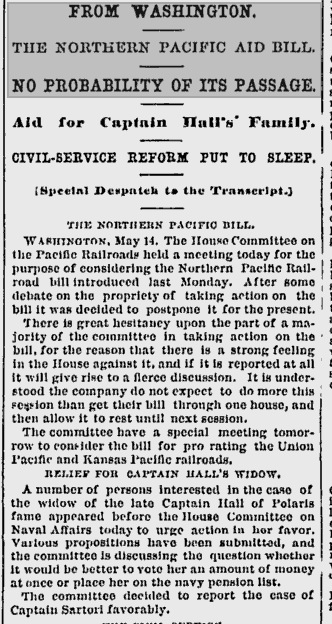
It was common for petitioners to circulate these small forms, which, signed by representative citizens from a given congressional district, could be distributed en masse in the hopes that a bill would be sponsored and introduced. I have searched available records, and cannot find specific evidence that such a bill was introduced in the House of Representatives, but it must have been, as Mercy Ann Hall's request appears later in the Congressional Record under the heading "Petition for assistance for the heirs of Captain Hall," sponsored by one George William Allen of Hall's home state of Ohio. The debate on this bill does not seem to have survived, although it appears it was referred to the Committee on Naval Affairs, and there's a small item in the Boston Evening Transcript saying that "a number of persons interested in the case of the widow of the late Captain Hall of Polaris fame appeared before the committee" and that they discussed "whether it would be better to vote her an amount of money at once or place her on the navy pension list."

A few days later, newspapers around the country reported that "The House Committee on Naval Affairs have agreed to report favorably on giving the widow of Captain Hall, of the Polaris, a pension of forty dollars monthly, and the pay due to her husband, amounting to about $2,000." Though seemingly generous --$40 would be about $750 in today's money -- this was in fact substantially less than the pension that would be given an actual US Naval Captain, which would have been more like $130 a month (more than $2,500 today). Alas, of the subsequent lives of Hall's widow and children, there seems to be very little record, and so it's difficult to say how long they lived to enjoy this pension, or whether they thrived in future years.

Monday, March 5, 2012

Arctic Shipwreck Conference in BC

Thanks to Dave Woodman for alerting us to an upcoming conference of the Underwater Archaeological Society of British Columbia, which features a host of talks which are sure to be of interest to anyone with the Frankin, among them Marc-Andre Bernier, head of Parks Canada's Underwater Archaeology program, on the wreck of HMS "Investigator," as well as Dr. Tim Ball on Jens Munk, Jacques Marc on the "Maud," and Dave Woodman himself on Franklin. You can get more information on the conference, and register online, at their site at www.uasbc.com. I certainly wish I could attend, and would urge everyone who can to do so.

Thursday, February 9, 2012

Improved Images of Franklin Relics

The National Maritime Museum has long been the host of the largest collection of Franklin relics in the world. A few have been on permanent display, but the vast majority are stored off-site, and are not accessible to the public. For the past ten years or so, small digitized images of some of these have been available, but the only way to get any higher resolution views has been to purchase them at a price prohibitive to most scholars. Now, under the umbrella of Royal Museums Greenwich, a vastly improved and more complete set of images is readily available. These include multiple views of many objects, and the all the views are scalable, which enables anyone interested in their features to see them at a level of detail good enough -- perhaps -- to make some new discoveries possible. I'd encourage anyone with a Franklin passion to visit the new site, and have at it -- one can see all manner of things, from the scraps of newspaper stuck in the "Peglar" pocketbook to the scratch-marks on the underside of a Franklin fork -- who know what this new imagery, with care, may reveal? There is even the capability to leave notes and annotations about specific objects, and share these with others using the resource.

This finally puts researchers around the world on an even footing, and that is a very welcome development.

Sunday, January 22, 2012

HBC Film from 1919-20 restored

The news is out about newly-restored footage from a travelogue film made in 1919 at the behest of the Hudson's Bay Company, Romance of the Far Fur Country. Although the actual prints of the film as shown in 1920 are lost, much of the source footage was uncovered in an HBC deposit at the BFI by historian Peter Geller, who wrote about the film in his book Northern Exposures: Photographing and Filming the Canadian North, 1920-45. Now, thanks to Winnipeg-based Five Door Films, and funding from the Manitoba Arts Council, a restored version, Return of the Far Fur Country, has been assembled, and is being screened across Canada, including in Nunavut where many of the scenes were filmed.

It's certainly historically significant footage, although as a commissioned film designed to show the HBC in a good light on the occasion of its 250th anniversary, it can't quite be considered a documentary in my mind (although the same might be said of Nanook of the North, which was paid for by the Révillon Frères fur company, which similarly expected that its activities be seen as benign and even beneficial). It's not by any means the earliest Arctic footage -- there were at least a dozen earlier "factual" films shot in the Arctic -- but since only a tiny proportion of this earlier footage survives, much of it in poor condition, this relatively pristine film is surely the earliest extensive view we have, or are likely to have, of the Arctic from the early twentieth century. I'm planning to see about getting some screenings down here in the U.S. closer to where I live, and if followers of this blog from other parts of the world are interested, I hope that they too will contact the producers.

Saturday, January 14, 2012

Lady Franklin's Ancanthe Under Threat

In 1839, during the time that Sir John Franklin was serving as Governor of Van Diemen's Land, Lady Franklin bought 130 acres of land near Hobart Town with the intention of setting up both a large botanical garden and an associated library and collection of natural history (many items of which she had collected). The museum building was fashioned after a Greek temple, and it and the surrounding gardens were to be known as "Ancanthe." Sir John Franklin himself laid the corner stone.

Alas, after the Franklins' departure, her Ladyship's plans languished; in 1853 all the collections and the library were removed, and the temple used to store apples and potatoes. Fortunately, the museum building itself was returned to the City of Hobart in 1936, with the stipulation that it not be moved, and be used in a manner consistent with Lady Franklin's intentions. The Art Society of Tasmania uses it for exhibition space, and that's surely something of which Jane would have approved.

Yet since then, the gardens and estate surrounding Ancanthe have been reduced again and again, with even the central ten acres facing incursions. And then, just recently, they have fallen under threat from a proposed subdivision whose backer, David Crean, has managed to avoid review by the full Hobart City Council. Concerned over the threat to this historically significant and beautiful property, local citizens have recently expressed their views, urging to City to purchase and permanently preserve the area adjacent to the original Ancanthe estate as public lands. They have established a Facebook page, the Save Ancanthe Group, and are urgently seeking donations and support. I urge every reader of this blog, and everyone with any interest in the vital historical ties between Sir John and Lady Jane Franklin and Tasmania, to support this cause, and let their views be known.