 The world of new-media "insta-documentaries" is getting more and more "insta" by the minute -- the Parks Canada Twitter Feed now announces a documentary of the rediscovery of HMS Investigator is soon going to be broadcast -- you can see the trailer here -- and will air on August 22nd, 25th, and 28th. From the tone of the trailer, a leading note will be the sovereignty issues related to the ship's discovery ...
Saturday, August 14, 2010
CPAC Documentary on HMS Investigator
The world of new-media "insta-documentaries" is getting more and more "insta" by the minute -- the Parks Canada Twitter Feed now announces a documentary of the rediscovery of HMS Investigator is soon going to be broadcast -- you can see the trailer here -- and will air on August 22nd, 25th, and 28th. From the tone of the trailer, a leading note will be the sovereignty issues related to the ship's discovery ...

Wednesday, August 4, 2010
HMS Investigator's Copper Sheathing
 The most significant aspect of the recently discovered remains of HMS Investigator is not where the ship was located, nor is it the graves found onshore nearby. Rather, it's the copper sheathing of her hull, so brilliantly visible in the most recently released video, a frame of which I've placed here for reference. Thanks to the low oxygen content of the frigid waters of Mercy Bay, the copper is not completely tarnished; indeed, underwater currents seem to have almost polished parts of it. The individual nails, as well as the Roman numerals used to mark off the draught of the ship during loading, are plainly visible. And, while some parts of the sheathing have been shredded or torn off entirely, in other areas it is nearly intact. This is significant for two reasons: 1) It shows that the ship was not heaved up by the ice in such a manner that the copper was readily accessible for any length of time, or the Inuit would surely have recovered more of it; and 2) We can conjecture, therefore, that less copper was recovered from this vessel than was earlier believed, which makes it more likely that copper found to the south and east near the Adelaide Peninsula came from some other source.
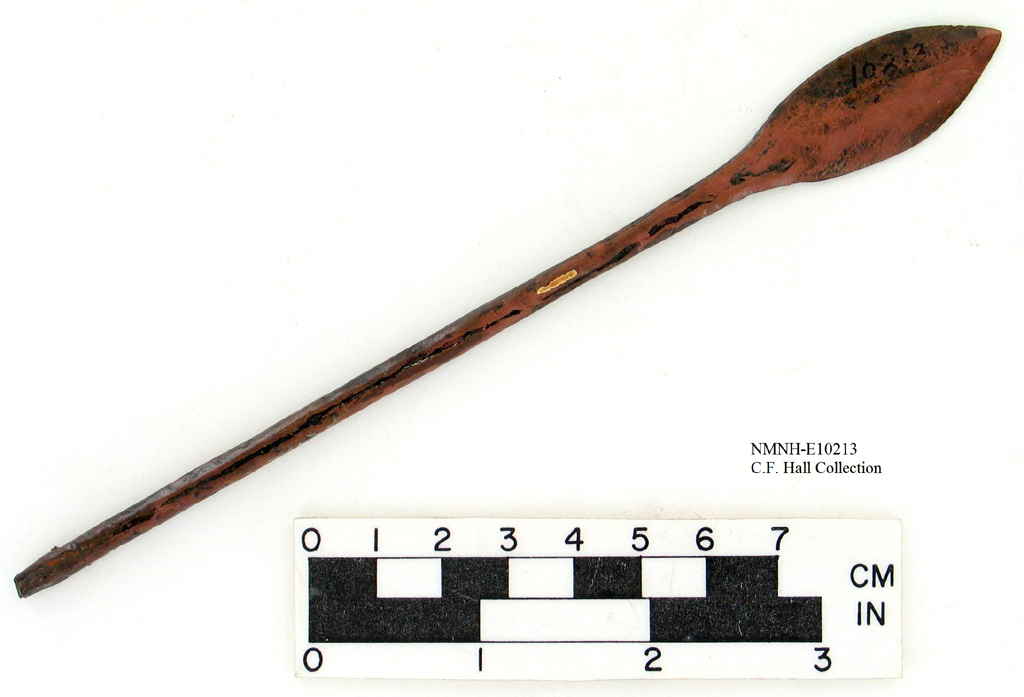
Could that mean the "Erebus" and "Terror"? Possibly, although evidence has recently surfaced which seems to indicate that neither vessel was given copper sheathing (see my earlier blog post here). Nevertheless, many of the ship's boats would have had it, and copper in other forms could have been recovered from the wrecks. Since the theory that the Investigator herself drifted to the area where Franklin's ships were abandoned is now disproved, the copper found there takes on potentially new significance. Of course, the copper could have been acquired by trade, but some bits of it, recovered by Hall, still bore the Royal Navy's "broad arrow" mark. It seems unlikely that this copper would have been traded such a distance without being cut up or reworked. I'm in the process of trying to get some images of Hall's copper; the Smithsonian has recently begun photographing artifacts from his collection, such as this lovely copper arrowhead. If any of it bears additional markings, it may well be possible to trace it further, and now that we can discount the Investigator as its source, it may be much more significant.
Friday, July 30, 2010
Thoughts on McClure and HMS Investigator
 In October of 2009, I was wandering among the tilted and neglected gravestones of London's Kensal Green Cemetery, in very good Arctic company -- my companions were Huw Lewis-Jones, Kari Herbert, and Kenn Harper. We had already found the graves of Sir John Ross and Sophia Cracroft, but time was growing short: darkness was about to fall, and the cemetery would soon be closed. The one further grave we sought was that of Vice Admiral Sir Robert John Le Mesurier McClure, the man officially credited as the first to traverse the Northwest Passage, and the last commander of HMS Investigator.
Was this crooked path between toppled stones "avenue 5"? Whose grave was this? Or this? We criss-crossed the twisted matrix of graves, passing by a placard which read:
It was hardly encouraging. And then, just at the last moment, I looked more closely at a sarcophagus-sized slab of pink granite, its edges encroached on every side by insolent grass. I rubbed at it with the toe of my shoe, and pieced out "THE NORTH WEST PASS..." Here it was.
Huw took some time to clear the stone, pushing back the grass and dirt with the help of a pair of borrowed gloves. One might imagine that the grave of the man officially recognized as having achieved the greatest dream of British navigators of the nineteenth century would have received more care -- but, as I found later, every grave at Kensal Green is the private property of the family of the deceased, and receives only such specific care as the family may provide. This grave, surely, ought to have received something more.
I thought about this grave when I heard of the re-discovery of McClure's ship, HMS Investigator, in Mercy Bay. A more remote place in the Arctic Archipelago is hard to imagine, and the sheer endurance of McClure and his men in the face of winter after winter of diminishing prospects is astonishing. That there were only three graves found on the nearby shore, and not thirty, is an enormous testament to McClure's leadership. In April of 1853, at a point well beyond that at which any rational man would have abandoned all hope, the men of the Investigator saw a speck on the horizon. Was it some kind of animal? No, it was a man! And, once it drew nearer, it was a man who spoke. As George Malcolm Thomson describes it,
He called : 'I am Lieutenant Pim, of the Resolute. Captain Kellett is in her at Dealy Island' (a hundred and sixty miles to the east). McClure and the lieutenant rushed forward and grasped his hand. In an instant, the scene on the ship was transformed. The invalids leapt from their hammocks. The artificers dropped their tools. The deck was crowded with wildly excited men.
It is difficult to fully comprehend the joyous ebullition of McClure's men -- and astonishing to think that it is this same deck, once crowded with overjoyed sailors, which we are seeing for the first time in 156 years. She now lies at the bottom of the crystal cold waters of Mercy Bay, almost precisely where she was upon that fateful day.
So, while I am a little annoyed by the very highly choreographed array of press releases, net-friendly videos, and hyperbolic tones of the coverage of this event, I am at the same time very deeply moved, and feel called upon to remember the courage of those men. Although Canada was, as yet, some years in the future, the spirit of that emergent nation was clearly manifest in the cheers that went up from that vessel on that day.
Wednesday, July 28, 2010
HMS Investigator Found
 The BBC News website has posted a story announcing that HMS Investigator has been found by the Parks Canada team. Of course, it was no great mystery where the Investigator was, but there were a few speculations as to its condition. Some had even argued that the Investigator might, like HMS Resolute, have drifted east and been the source of reported sightings of the Erebus and Terror, or that the mast seen by the men of the Anderson expedition was hers. These theories, at least, can be laid to rest.
According to the Parks Canada team, the ship is upright and in remarkably good shape; according to Canadian Environment Minister Jim Prentice, "You can make out all the planking on the deck, the details on the hull, all of the detail of the timber." Hopefully, it will not be too long before some of this imagery is shared with the public, particularly the Canadian public who have provided the funding and resources used to locate the vessel. No word yet on the copper sheathing. The only other detail is that the archaeologists have relocated the three graves (why do Arctic graves always seem to come in threes?) of members of the expedition who died of scurvy. Apparently inquiries are being made as to the disposition of these human remains, but the plan for Investigator herself is to leave the ship undisturbed.
Friday, July 23, 2010
BBC Coverage of Franklin Search
 The trickle of news stories about this summer's Franklin search continues, this time with a refreshingly well-informed and in-depth piece from the BBC News website. While the article gives some account of the overall plans, the focus is on the search for the remains of HMS Investigator. We learn now that the team will be headed by Parks Canada archaeologist Ryan Burns, assisted by Jonathan Moore and Thierry Boyer. According to this story, the team headed by Harris will head up to Mercy Bay via Twin Otter, where, with the assistance of an unnamed Inuvialuit guide, they will begin their search. It's not quite clear when they will arrive, but I was interested to see that this same team, after its work at Mercy Bay is completed, will by flown to the icebreaker Sir Wilfrid Laurier, and will participate in the search for the "Erebus" and "Terror." This is encouraging, as it suggests to me that both parties will have sea and land search capability. I'll keep readers of this blog posted as I hear of any new developments.
Tuesday, July 6, 2010
German coverage of 2010 Franklin Search
 In the 1850's, the search for Sir John Franklin captured the attention of all of Europe, with headlines in every language. McClintock's narrative was translated into French and German within a few months of its publication, and international interest in further searches remained strong.
Now, with a renewed search this summer, the Franklin story is once again attracting attention in the EU, particularly in Germany. German interest has always been strong, spurred by the immense success of Sten Nadolny's novel Die Entdeckung der Langsamkeit (English: The Discovery of Slowness) in 1983. A week or so ago, I heard from Gerd Braune, a journalist in Ottawa, that he was preparing a piece on the new Franklin search for several German-language papers. He asked for, and I gave him, permission to use a photo I'd taken of the Franklin expedition graves on Beechey Island.
Just yesterday, he sent me copies of the resulting article. It's available here at Diepresse.com, and you can also see .pdfs of the large, illustrated versions in the Luxemburger Wort as well as Die Rheinpfalz. The articles are informative and well-written (I don't read or speak German, but my daughter has been studying the language for some time, and was able to translate them for me), and contain a few additional details -- my personal favorite comes at the end, where perennial Franklin pointman Louie Kamookak muses laughingly that, if the ships are found based on his information, he may henceforth be known as "Sir Kamookak."
Thursday, July 1, 2010
More on this summer's Franklin search
 The CBC has just come out with a report giving some fresh details of this summer's search for the "Erebus" and "Terror," the ships of Sir John Franklin's last expedition. According to this article, the searchers have secured three weeks' use of the CCGS Sir Wilfred Laurier this August. Strangely, Robert Grenier's name is not mentioned, but Ryan Harris, described as a "senior marine archaeologist" is quoted describing the mission, and the inevitable Louie Kamookak is also set to be on board. The search is to concentrate on the "waters southwest of King William Island," a description which could take in any area on the western coasts of the Adelaide Peninsula, or in eastern Queen Maud Gulf. The exact method or area of search are not described, though presumably the hope is to locate some initial targets, and use side-scan sonar operated from the vessel to obtain more detailed imagery. It's not clear whether, as Grenier has in the past done and called for, associated land-based parties will be looking for other physical artifacts.
Monday, June 28, 2010
Expanded 2010 search for Arctic Ships
 Thanks to Kenn Harper (who sent me a link to the story) and Randy Boswell, whose reporting on this issue has always been a great source of updates on the Franklin search, I can report that Parks Canada -- in addition to the continued search for the "Erebus" and "Terror" under the direction of Robert Grenier -- is also planning a summer search for the remains of Robert McClure's HMS Investigator in Mercy Bay.
 This story, reported via the CanWest news service, and available at the site of the Saskatoon Star Phoenix, indicates that Marc-Andre Bernier, who like Grenier is an underwater archaeologist with Parks Canada, is hoping to use side-scan sonar to locate the remains of the Investigator in Mercy Bay; there will also be archaeological excavations along the bay's edge, near the site where McClure cached supplies in 1853.
The project will not, according to Bernier, have any impact upon the search for Franklin's ships, which is still planned for "late August." Although the article doesn't say so, I expect that this is because the search for McClure's ship will be conducted from atop the bay ice, drilling and dropping sonar booms, whereas the Franklin search is apparently still counting on open water to conduct its search from aboard a research vessel.
Certainly, it would be of great value to be able to get some visual images of the Investigator, if for no other reason to ascertain the state of the copper sheathing of its hull. This sheathing had already been significantly damaged by the ice before abandonment (McClure reported that it was hanging in ribbons from the sides), but also because there was said to have been significant recovery of this copper by the Inuit. If indeed a substantial proportion of the copper is missing, this would confirm that Inuit did come into possession of this prized resource, and might correlate with the finds of copper in the region, some pieces of which bore the "broad arrow" of the Royal Navy. I'll certainly pass along anything further I can learn about this exciting development.
Tuesday, June 8, 2010
The Halkett Boat
 One of the lesser-known aspects of both the Franklin Expedition of 1845 and those who searched for it in the ensuing decade and a half was their use of the Halkett inflatable boat. Just today, I saw that the current featured article on the Wikipedia is a quite thorough and informative one about the Halkett Boat, and wanted to bring it to the attention of everyone here.
The Halkett boat was the brain-child of Peter Halkett, a lieutenant in the Royal Navy. It was singular not only for its use of waterproofed rubberized cloth to make an easily portable inflatable boat, but for design features which rendered it especially valuable for use on expeditions where both land and water travel might be rendered necessary by conditions such as drifting ice, open leads in the water, or difficult portages. He even developed a version of the boat which could be disassembled and worn as clothing -- this is the type shown here. The sail doubled as an umbrella, and the oars as walking sticks; the boat itself could be disassembled and "worn" as waterproof clothing by two men.
The design earned early praise from Sir John Richardson, who was likely the one who recommended it for Franklin's use. The design had only just been finalized, with Halkett having tested it on the Thames in 1844. The boat brought by Franklin was not, technically speaking, an officially-supplied item, but Halkett was eager to hear how it might perform in the Arctic, and Franklin was willing to give it a try.
Remarkably, there is a body of Inuit testimony which confirms the use of a Halkett boat; their description of it is accurate enough that there can be little doubt they saw one in use:
"[Aglooka had with him] a boat that had places on the sides that would hold wind ... with hollow places in the sides for wind (air) to hold it up when in the water ... There were sticks or holes for this boat, to keep it open (spread) when needed. This small boat was wrapped or rolled up in a bundle or pack, and carried on the shoulder of one of his men" (qtd. in Woodman, Unravelling the Franklin Mystery, p.309).
Unfortunately, since John Rae's and James Anderson's parties were also equipped with Halkett boats, and Rae was also known as "Aglooka," it's very difficult to determine with certainty whether or not this Inuit account refers to Franklin's men. It's widely assumed that some of those who crossed Simpson's strait did so in a Halkett boat, though accounts of an overturned whaleboat on the mainland side suggest this is not the only viable explanation.
But for more on this remarkable invention, I can only recommend the Wikipedia entry, which is far more detailed and better illustrated than anything I have seen in printed sources.
Saturday, May 22, 2010
Baldwin: Hero or Villain?
 Evelyn Briggs Baldwin is surely one of the least well-known of Polar explorers, and according to some historians, his obscurity is richly deserved. To them, he is a man whose poor judgment was pivotal in the failure of two major Polar expeditions: that of Walter Wellman's in 1898, as well as in the richly-supplied but poorly planned Baldwin-Ziegler expedition of 1901, which he commanded. And yet there is at least some evidence that this blame may be misplaced, and that Baldwin's seeming failures were, in fact, evidence of a wise and hard-earned sense of caution.
Baldwin got his start working as a meteorologist with Robert Peary in Greenland in 1893-4. He apparently caught the Arctic bug, and in 1896 published a weighty tome, The Search for the North Pole. Or, Life in the Great White World. On the title page of this book, which was sold by subscription, he listed himself as a "Member of the Chicago Academy of Sciences, Member of the National Geographic Society, Non-resident member of the Geographical Club of Philadelphia," and "formerly Assistant Observer, United States Weather Bureau." It was a slender portfolio, but his enthusiasm was enormous; the book opened with a ferocious defense of the value of Polar exploration, and continued through accounts of every explorer from the Vikings to Franklin to Peary. Some of the funds thus earned apparently helped him undertake a personal voyage to Spitzbergen in 1897, but his real test came when he was engaged by Walter Wellman as second-in-command of the magnate's first Polar attempt (and his only by land) in 1897. There, he led an advance party through truly horrific ice conditions in order to establish depots and a forward camp, while Wellman stayed back at the expedition's comfortable headquarters, known as "Harmsworth House." After enormous hardships, Baldwin succeeded in establishing the forward camp, and left two men there to await the arrival of the full expedition the following spring.
William Mills, in his reference work Exploring Polar Frontiers, blames Baldwin for leaving the men with inadequate supplies, and says that "Wellman himself was horrified" when they arrived to find one of the men dead and the survivor sleeping next to his corpse. Yet as my good friend P.J. Capelotti notes in his book By Airship to the North Pole, Wellman's orders to Baldwin were numerous, contradictory, and in some cases impossible; it was these orders, and not Baldwin's efforts to follow them, that were most to blame. Wellman ignored Baldwin's letters expressing concerns about supplies and conditions; he possessed an optimism as vast as his experience was limited, and complained that Baldwin was "too prone to look on the dark side of things." Neither man, in any case, knew that one of the two left in the camp, Bentzen -- a veteran of Nansen's voyage on the Fram -- had slipped into delirium not long into the winter, forcing the other man, Bjoervig, to care for him for eight weeks before the sufferer finally died. Capelotti has published Baldwin's detailed journal of this expedition, and it's hard to read more than a few pages of it without being overcome by a desire to go back in time and give Wellman a sound thrashing.
Mills seems to think that rumors surrounding the earlier incident would have followed Baldwin to his next expedition, and the only one he was to command. The Baldwin-Ziegler expedition of 1901 had the finest equipment money could buy, and supplies that were lavish when compared to those to which Peary or other polar veterans were accustomed. Not one but three ships were placed at its command, and its base station -- fixed up in the shadow of the Duke of Abruzzi's earlier camp -- boasted solid wood-frame buildings unparalleled since the days of Greely's Fort Conger. Here again, Baldwin had the task of establishing forward camps, and by all accounts did so capably. Mills harshly blames Baldwin's decision to avoid the added weight of tents and sleeping bags for the forward team, as several members suffered from frostbite -- but this was only after they had become lost and disoriented. When the heavily-laden resupply ship failed to reach the base camp, Baldwin did as he'd been told and released a series of message balloons, none of which was found until years later. Receiving no response, and concerned over the dwindling supplies of coal, Baldwin decided to retreat back to safety. His unexpected appearance in Tromsø without results infuriated Ziegler and cost him his command -- but it may well have saved the lives of many of his men.
In later years, Baldwin never tired of telling his accounts; as Capelotti notes, he was a meticulous record-keeper, and his papers are a goldmine of information. Late in life, he set about petitioning the U.S. government for some recognition and financial support in return for his service, but never received either; at the age of 71 in 1933, he was struck and killed by a passing motorist in Washington, DC. A copy of his book -- long ago de-accessioned by a local library, and missing its spine and back cover -- was given to me by a student, and I had to confess that, when I first browsed through it, I had no idea who Baldwin was.
Wednesday, May 19, 2010
Lords Franklin
 Over the (now) more than hundred and sixty years since his disappearance, the fame of Sir John Franklin shows little sign of diminishing; in just the past year we've had a new biography, as well as yet another novel (by my count, the seventeenth) based on his life. And setting written texts aside, one of the most enduring sources of interest in Franklin's fate surely derives from the ballad known as "Lord Franklin" or "Lady Franklin's Lament." It was hearing the late Michael O Domhnaill's version of this song some twenty years ago that began my own Franklin fascination, and as time has passed I have accumulated other recordings of this plaintive ballad, a habit accelerated by the digital age. At last count I have more than forty different versions in my music library, and I'm certain that my collection is very far from complete.
The history of the ballad itself and its variants would make a long story, but suffice it to say that about 90% of the versions I know are based on Martin Carthy's 1966 version, released on his Second Album LP. Carthy shortened the lyrics to five well-rounded stanzas, and his slight variation of the source melody (an Irish air known as "The Croppy Boy" or Cailín Óg a Stór) has been universally carried forward. What follows is my own personal account of what I think are the best (and worst) versions, with a few comments on the more notable variations -- I hope that, should this ballad be one of your favorites, I might help you find further versions to enjoy, and avoid the (relatively few) awful ones.
As I say, Michael O Domhnaill's version, with his reedy yet potent voice, was the first I heard, and it remains my personal favorite. The well-known version by Pentagle is also a classic, and John Renbourn's guitar work on the tune is second to none. Another outstanding traditional version is John Walsh's from his album Aon Dó Trí (that's one two three in Irish); another by Take Two (the moniker of two Shropshire lads name of Dave Rolfe and Kevin Arnold) is also memorable. Special mention for over-use of echo should go to Sinéad O Connor's otherwise lovely recording, although rumor has it that an echo-free version is floating around the ether somewhere.
Rockier, or poppier versions also abound; that by the Glasgow-based Pearlfishers is the prize among these, though capable covers by the Tramps, Carmina, or Connie Dover are also appealing. For those who, at the other end of the spectrum, feel that anything more than a raspy a capella is too fancy, the Revels' version on their Homeward Bound CD is to my mind the best of the foke'sull school. I would warn, though, against the traditional version offered by "The Seamen's Institute" -- the tuneless warble of the unnamed singer on their version sounds rather like Sterling Holloway (the voice of Disney's Winnie the Pooh) after a night of excessive mead-guzzling.
One might well ask why a ballad which -- at least in part, and in some versions entirely -- is sung from Lady Franklin's point of view, why there have not been more versions by women. The gender imbalance has been greatly rectified in the digital age, with at least ten new recordings in the past decade. I'm personally fond of Jo Freya's version, with its pennywhistle and concertina accompaniment; Louise Killen's version, from her "Stars in the Morning" album, is also quite enchanting. The vocal treatment by the "Roots Quartet," alas, is far less felicitous; not only is the melody transposed into a modal version, but it's festooned with tinny harmonies that are reminiscent of a Roches outtake.
Lastly, there are a few instrumental-only versions, of which that recorded by Giuseppe Leopizzi and Roselina Guzzo is particularly rich and resonant. The melody has also been appropriated for other songs, among them Bob Dylan's "Bob Dylan's Dream" and David Wilcox's haunting "Jamie's Secret," which transposes the tale of Franklin's loss to the loss of a friend in the North Cascades of Washington State.
I'd be interested to hear from anyone who feels a favorite version has been slighted, or who disagrees with any of my calls!
Subscribe to:
Comments (Atom)