Tuesday, March 13, 2012

A Prisoner of Sir John Franklin

As someone who has spent the last 20 years researching the final Arctic expedition of Sir John Franklin, I must admit it came as a bit of a surprise to me to discover that my great-great-grandfather was, in 1841, sentenced to ten years transportation to Van Diemen's Land, becoming (at least in the official sense) a prisoner of Sir John's. I have always read that Franklin was, in every way that he could be, a humane man when dealing with the transported convicts of the territory, indeed perhaps too much so, such that the settlers resented what they saw as favoritism. I will certainly hope that this was true at any rate!

My ancestor, William Henry Brunt, was known to his descendants as "Bill." My grandfather used to recite a rhyme about him, although alas by the time I asked him to repeat it so that I could write it down, all he could remember was this:

Bill Brunt was a thief, and that we all know,
He stole John ... ... ...
But they caught him down below.

But John who? And what? Happily, the Old Bailey project solved the mystery, declaring in a few words that:
WILLIAM HENRY BRUNT was indicted for feloniously breaking and entering the dwelling-house of John Grace, and stealing therein, 1 blanket, value 6s.; 1 pair of trowsen, value 5s.; I frock, value 2s.; 2 handkerchiefs, value 1s.; and 1 knife, value 6d.; the goods of William Henry Stevens; to which he pleaded GUILTY. Aged 21.— Transported for Ten Years.
So the rhyme ought to have gone "he stole John Grace's trousers" or something along those lines. In any case, off he went aboard the "Tortoise," which sailed on the 28th of September 1841 for Van Diemen's land. Of his ten years there I know nothing -- now I'll have to see what I can find out -- but I do know that, once his sentence was up, he emigrated to Canada, where homesteads were being offered for those willing to try a living off the land; his plot was near the town of Durham, Ontario, just south of Georgian Bay. Apparently, it did not turn out to be a profitable endeavor, but during that time he married and started a family, into which my great-grandmother, Mary Ann Brunt, was born on 16 July 1860. The whole family headed west to Vancouver, and from there to the little town of Sedro-Wooley, Washington Territory.

The photo above shows Mary with her son, my grandfather, Ralph Potter, and was probably taken around 1930, when Mary would have been 70 years old, and my grandfather a youthful 35. Mary had married his father, Miles Potter, in 1883, and would live to see my father, Ralph Miles Potter, who was born in 1927.

Who knew!

Mercy Ann Hall

Among the more remarkable objects in the Hall Papers at the Smithsonian is a small printed form, one of an unknown number prepared by the widow of Charles Francis Hall in the wake of his death while commanding the USS Polaris expedition in search of the North Pole. Hall was, it's true, in a somewhat unusual position on the Polaris, even before his death and probable murder -- a "Captain" who had no navigational experience (these duties were delegated to Budington in Hall's orders), a commander with no military or naval rank, and an explorer whose sole credential was having explored before. His death thus left his surviving family with no benefits, pension, or other funds as would have been automatically granted had Hall been, say, a naval officer. Thus it was that in 1874 Mercy Ann Hall petitioned the US Congress for some payment in recognition of her late husband's "fourteen years of arduous and dangerous toil," during which he was "unsparing of himself or his family." The latter part of her claim is, if anything, an understatement; in all the years after Hall first left Cincinnati in 1860, he had seen his oldest son -- Charles Jr. or "Charlie" as he was known -- only twice, and only for a few days on each occasion. By the time of this petition, Charlie was seventeen, and his younger sister was thirteen -- to them, alas, their famous father was a man they hardly knew.

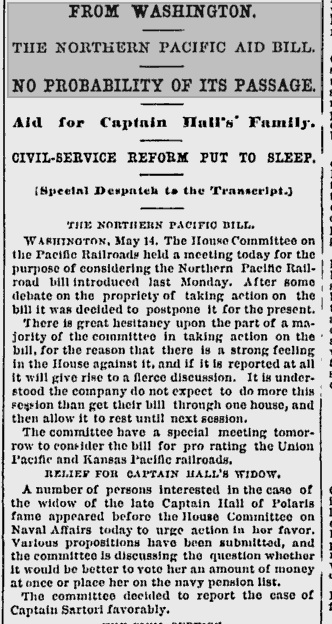
It was common for petitioners to circulate these small forms, which, signed by representative citizens from a given congressional district, could be distributed en masse in the hopes that a bill would be sponsored and introduced. I have searched available records, and cannot find specific evidence that such a bill was introduced in the House of Representatives, but it must have been, as Mercy Ann Hall's request appears later in the Congressional Record under the heading "Petition for assistance for the heirs of Captain Hall," sponsored by one George William Allen of Hall's home state of Ohio. The debate on this bill does not seem to have survived, although it appears it was referred to the Committee on Naval Affairs, and there's a small item in the Boston Evening Transcript saying that "a number of persons interested in the case of the widow of the late Captain Hall of Polaris fame appeared before the committee" and that they discussed "whether it would be better to vote her an amount of money at once or place her on the navy pension list."

A few days later, newspapers around the country reported that "The House Committee on Naval Affairs have agreed to report favorably on giving the widow of Captain Hall, of the Polaris, a pension of forty dollars monthly, and the pay due to her husband, amounting to about $2,000." Though seemingly generous --$40 would be about $750 in today's money -- this was in fact substantially less than the pension that would be given an actual US Naval Captain, which would have been more like $130 a month (more than $2,500 today). Alas, of the subsequent lives of Hall's widow and children, there seems to be very little record, and so it's difficult to say how long they lived to enjoy this pension, or whether they thrived in future years.

Monday, March 5, 2012

Arctic Shipwreck Conference in BC

Thanks to Dave Woodman for alerting us to an upcoming conference of the Underwater Archaeological Society of British Columbia, which features a host of talks which are sure to be of interest to anyone with the Frankin, among them Marc-Andre Bernier, head of Parks Canada's Underwater Archaeology program, on the wreck of HMS "Investigator," as well as Dr. Tim Ball on Jens Munk, Jacques Marc on the "Maud," and Dave Woodman himself on Franklin. You can get more information on the conference, and register online, at their site at www.uasbc.com. I certainly wish I could attend, and would urge everyone who can to do so.

Thursday, February 9, 2012

Improved Images of Franklin Relics

The National Maritime Museum has long been the host of the largest collection of Franklin relics in the world. A few have been on permanent display, but the vast majority are stored off-site, and are not accessible to the public. For the past ten years or so, small digitized images of some of these have been available, but the only way to get any higher resolution views has been to purchase them at a price prohibitive to most scholars. Now, under the umbrella of Royal Museums Greenwich, a vastly improved and more complete set of images is readily available. These include multiple views of many objects, and the all the views are scalable, which enables anyone interested in their features to see them at a level of detail good enough -- perhaps -- to make some new discoveries possible. I'd encourage anyone with a Franklin passion to visit the new site, and have at it -- one can see all manner of things, from the scraps of newspaper stuck in the "Peglar" pocketbook to the scratch-marks on the underside of a Franklin fork -- who know what this new imagery, with care, may reveal? There is even the capability to leave notes and annotations about specific objects, and share these with others using the resource.

This finally puts researchers around the world on an even footing, and that is a very welcome development.

Sunday, January 22, 2012

HBC Film from 1919-20 restored

The news is out about newly-restored footage from a travelogue film made in 1919 at the behest of the Hudson's Bay Company, Romance of the Far Fur Country. Although the actual prints of the film as shown in 1920 are lost, much of the source footage was uncovered in an HBC deposit at the BFI by historian Peter Geller, who wrote about the film in his book Northern Exposures: Photographing and Filming the Canadian North, 1920-45. Now, thanks to Winnipeg-based Five Door Films, and funding from the Manitoba Arts Council, a restored version, Return of the Far Fur Country, has been assembled, and is being screened across Canada, including in Nunavut where many of the scenes were filmed.

It's certainly historically significant footage, although as a commissioned film designed to show the HBC in a good light on the occasion of its 250th anniversary, it can't quite be considered a documentary in my mind (although the same might be said of Nanook of the North, which was paid for by the Révillon Frères fur company, which similarly expected that its activities be seen as benign and even beneficial). It's not by any means the earliest Arctic footage -- there were at least a dozen earlier "factual" films shot in the Arctic -- but since only a tiny proportion of this earlier footage survives, much of it in poor condition, this relatively pristine film is surely the earliest extensive view we have, or are likely to have, of the Arctic from the early twentieth century. I'm planning to see about getting some screenings down here in the U.S. closer to where I live, and if followers of this blog from other parts of the world are interested, I hope that they too will contact the producers.

Saturday, January 14, 2012

Lady Franklin's Ancanthe Under Threat

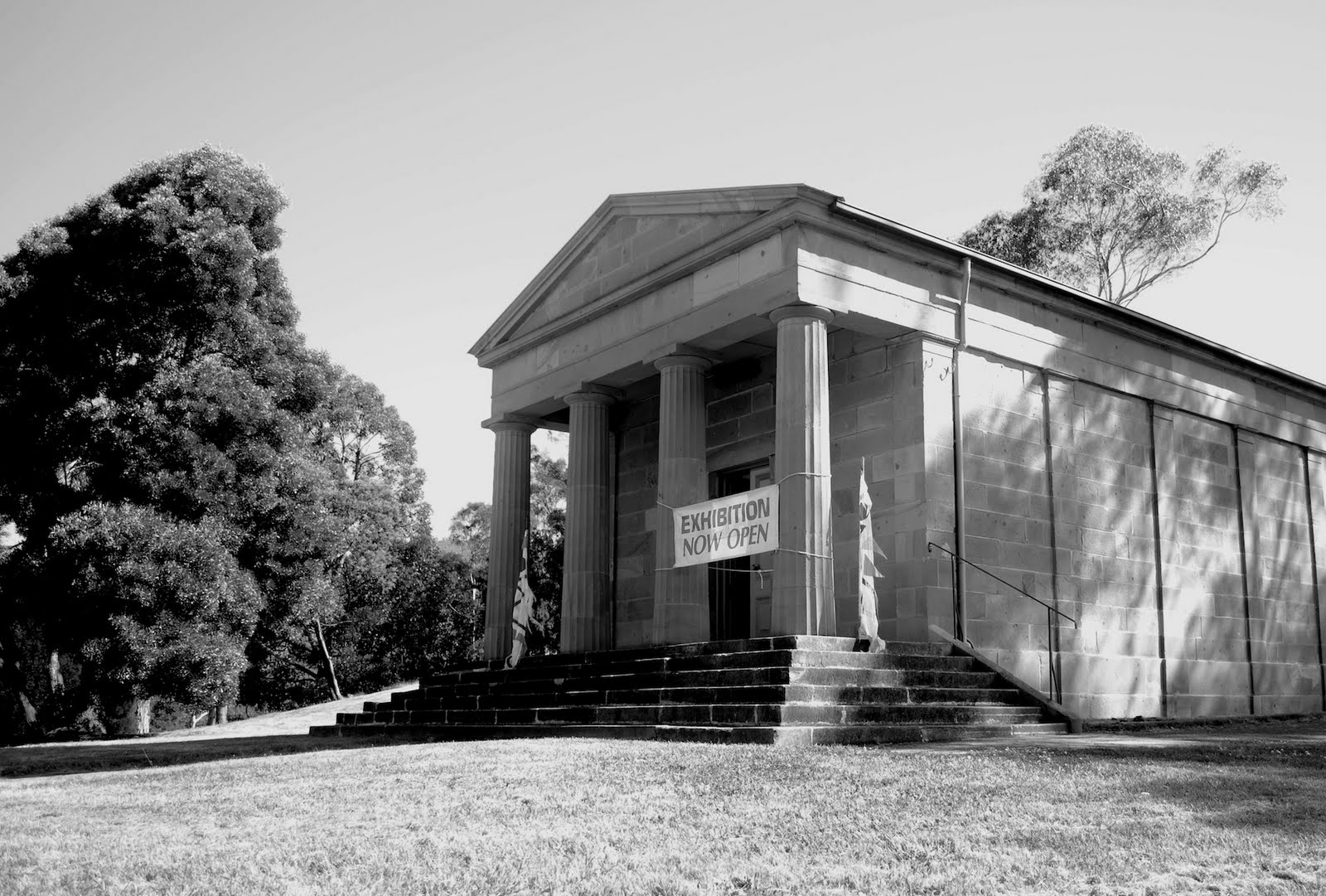
In 1839, during the time that Sir John Franklin was serving as Governor of Van Diemen's Land, Lady Franklin bought 130 acres of land near Hobart Town with the intention of setting up both a large botanical garden and an associated library and collection of natural history (many items of which she had collected). The museum building was fashioned after a Greek temple, and it and the surrounding gardens were to be known as "Ancanthe." Sir John Franklin himself laid the corner stone.

Alas, after the Franklins' departure, her Ladyship's plans languished; in 1853 all the collections and the library were removed, and the temple used to store apples and potatoes. Fortunately, the museum building itself was returned to the City of Hobart in 1936, with the stipulation that it not be moved, and be used in a manner consistent with Lady Franklin's intentions. The Art Society of Tasmania uses it for exhibition space, and that's surely something of which Jane would have approved.

Yet since then, the gardens and estate surrounding Ancanthe have been reduced again and again, with even the central ten acres facing incursions. And then, just recently, they have fallen under threat from a proposed subdivision whose backer, David Crean, has managed to avoid review by the full Hobart City Council. Concerned over the threat to this historically significant and beautiful property, local citizens have recently expressed their views, urging to City to purchase and permanently preserve the area adjacent to the original Ancanthe estate as public lands. They have established a Facebook page, the Save Ancanthe Group, and are urgently seeking donations and support. I urge every reader of this blog, and everyone with any interest in the vital historical ties between Sir John and Lady Jane Franklin and Tasmania, to support this cause, and let their views be known.

Friday, December 30, 2011

Strange Graves

When the New York Times ran a blog post on its Dot Earth blog about the ballad "Lord Franklin," they chose as an illustration a curious engraving. It comes from a June 1881 issue of the Illustrated London News, and was one of many large plates showing scenes from Schwatka's search for Franklin. This one was captioned: "THE AMERICAN FRANKLIN SEARCH EXPEDITION: GRAVES OF THE COMRADES OF SIR JOHN FRANKLIN." So it would seem an ideal illustration for blog about the famous ballad lamenting the lost of Sir John and his "gallant crew," except for one detail: the graves shown here are certainly not those of Franklin or his crewmembers. The only graves, in the sense of organized burials with grave markers, are those found on Beechey Island; there were only three, until an unlucky crewman aboard the "North Star" joined them to make a party of four. And yet here we see what appear to be sixteen graves, three of which feature enormous columns that would seem to be made of wood or stone -- two obelisks and one cross.

So where is this graveyard -- with a village of igloos and an ice-bound ship near at hand? I think I have a likely answer, but rather than offer it here, I thought I'd "crowd source" the question: whose graves are these, and how did they end up being depicted in such a lovely but mistitled engraving?

(p.s. the version here is scanned from my own personal copy, not from the Times or the collection credited there).

Sunday, December 4, 2011

Tima and Chimo

The first use of "Chimo" as a greeting is in Drage 1748, in Hudson Strait: "The Person in the Canoe... shewed a Piece of Whale-bone, repeating Chimo, and moving his Left-hand circularly upon his left Breast..." Andrew Graham in 1768 wrote that the Eskimos "rub their breast with their open hand, calling in a pitiful tone, 'Chimo! Chimo! which is a sign of peace and friendship. Hearne records "Tima" in 1795: "Tima in the Esquimaux language is a friendly word similar to 'what cheer.'" Edward Chappell in 1814 wrote that "Chymo" meant to barter.

These words each derive, in my opinion, from words that have their own discreet meaning, but in this context of being used as a greeting they have merged. George Back (1836-37) suggested as much when he referred to the men he met "vociferating their accustomed 'Tima' or 'Chimo'..." And McTavish in the 1880s wrote, "I bade the majority of the Esquimaux 'Timah,' generally written as 'Chimo'"

Taima (the modern correct spelling of tima - teyma - timah) today means - that's all, that's enough, it's over.

Chimo (which I think traditionally was pronounced Saimo - like Sigh-moe) comes from a root "saimak" which means blessing or peace. Saimaqsaiji means peacemaker. Saimati in northern Quebec and southern Baffin is "flag" - because after conversion Inuit stuck white flags into the snow beside their snowhouses to show that they were Christian and therefore peaceful. The phrase "saimugluk" (used between two people) today is always accompanied by a handshake, but derives from the same root, so it can be thought of as once meaning "Let's be friends," "Let's be in peace."

So the Taima and Chimo of the early white explorers and traders converged. The meaning was one of friendship and peace, with overtones of barter at the time.

None of this helps us understand "Mannik toomee."

Saturday, December 3, 2011

Mannik toomee

The image is almost a cliché of nineteenth-century Arctic explorers' narratives: the Kabloonas approach the "Esquimaux" carefully, and the natives, weapons in hand, crouch nervously, never perhaps having encountered white men before. And then, with a cry of "Teyma," "Mannik toomee," or "Kammik toomee"-- all words thought at one time or another to mean "Friend," "Peace," or "Welcome" -- the two parties instantly relax; handshakes are exchanged, and trade goods soon follow. Thank goodness the white people knew what to say!

But of course they didn't know what to say. Most British and American explorers did not know a single word of Inuktitut; if they had phrasebooks, these were often in the wrong dialect, and if they had interpreters these were often Greenlanders whose dialect was -- quite literally -- thousands of miles off. The Brits, and the Americans who followed them, also had a habit of taking any word or phrase spoken to them, interpreting it by context and gesture, and using it in return as a greeting.

Which brings us to "Mannik toomee," subject of part of my last posting. This phrase or something close to it is in the journals of many Arctic explorers, each of whom heard it a little differently; McClintock heard it as "Kammik toomee," Schwatka as "Munnuk toomee," and Hall as "Man-nig-too-me." Taken literally, it seems to be made up of either manik ("here") or kamik ("sealskin boot"), which is followed with tumiq ("tracks"?). In an agglutinative language such as Inuktitut, this could be construed as anything from "there are tracks here" to "here we stand" -- but my knowledge of the language is extremely limited, so I'd leave that to those who speak it, or linguists. The one thing I can say with some certainty is that it doesn't mean "Welcome," which is what the explorers thought it did.

It appears that this is one of those phrases, heard by white men at one point in time, and then re-used as a greeting. Since white men wrote down what they heard, later explorers might well re-use the term. "Teyma," assumed to mean "friend," was noted by Sir John Franklin in 1821, who remarked that it was "used by Esquimaux when they accost strangers in a friendly manner." Later explorers used it too, though at some point they seem to have switched to a variation of "Mannik toomee" -- so the question is, who first heard this expression, and made the assumption it was a friendly greeting?

Here things get sticky. I have a clear recollection that I'd read it was spoken by the angekoq or shaman who, in 1833, tried to keep the kabloonas led by George Back -- who, unbeknownst to Back, had earlier killed three Inuit -- from coming too close. But it's not in Back's, or in King's narrative. It does, however, feature in Inuit oral tradition. Dorothy Eber heard this phrase in a story about nervous Inuit approaching white men, and wrote about it in The Beaver and again in her most recent book. Her informant even offered a gloss on its meaning:
The shaman told his people, 'Maniktumiq' - do it smoothly, not aggressively. The Inuit stood together and said the same word - 'Maniktumiq' - do it smoothly. It was sort of a prayer to a great power, the spirit. All together they began walking gently and smoothly, not agressively.
Eber believed the word was a specialized, "magic" or shamanistic word, used for its symbolic rather than literal meaning -- like, say, the English word "abracadabra" -- and that it may well have been the kind of word used only by a particular band, or even one specific shaman.

I believe this phrase may have been specific to the Utjulingmiut. This was the band Back met near the mouth of the river that would later bear his name, the band whose hunting area was nearest the site of the last Franklin ship, and the band which, due to famine and hostile neighbors, was dispersed to the winds, its survivors often finding refuge with other bands. Eber believes the testimony just quoted referred to Ross -- and indeed a similar scene happened at his first meeting with the Inuit. But where then is any reference to the man with one leg, sent ahead as the most expendable member (and later given a welcome wooden replacement by the ship's carpenter of the Victory)? No, I think this account is a worn-down version of the Inuit encounter with Schwatka's searchers in 1878; here is his version:

They formed a line with bows, arrows, and spears or knives, and, as we moved up to within a few feet, they began a general stroking of their breasts, calling "Munnik toomee" (Welcome).

The association of this gesture with the phrase is noted elsewhere -- but what is significant here is that this band, although from another area, had as its head-man one of the last survivors of the Utjulingmiut diaspora.

Incidentally, this also gives us another reason to suppose that "Too-loo-ark" may have been Franklin -- it was Franklin who picked up on "teyma," and according to Kok-lee-arng-nun, it was "Too-loo-ark" who added that phrase to his greeting:
Too-loo-ark would say "Ma-my-too-mig-tey-ma." Ag-loo-ka's hand shaking was short and jerky, and he would only say "Man-nig-too-me." After the first summer and first winter, they saw no more of Too-loo-ark.

Wednesday, November 30, 2011

Kok-lee-arng-nun's Tale

One of the most remarkable pieces of Inuit testimony was that given the Charles Francis Hall by a native in Pelly Bay whose name Hall transcribed as "Kok-lee-arng-nun." This old man, nearly blind, had two spoons of Crozier's, and happily volunteered his tales of visiting white men on ships. There was one boat which had been near where they were speaking (this must have been Ross's Victory) and two boats out near "Oot-joo-lik." His tale of visits to these two boats, at first, seemed very clearly to describe Franklin and Crozier, under the names "Too-loo-ah" and "A-gloo-ka."

He described "Too-loo-ah" as "an old man with broad shoulders, thick and heavier set than Hall, with gray hair, full face, and bald head. He was always wearing something over his eyes (spectacles, as Too-koo-li-too interpreted it), was quite lame, and appeared sick when they last saw him. He was very kind to Innuits -- always wanting them to eat something." With this man was his second officer, "Aglooka" -- Kok-lee-arng-nun showed how Too-loo-ark and Ag-loo-ka used to meet him. They would take hold of his hand, giving it a few warm and friendly shakes, and Too-loo-ark would say "Ma-my-too-mig-tey-ma." Ag-loo-ka's hand shaking was short and jerky, and he would only say "Man-nig-too-me." After the first summer and first winter, they saw no more of Too-loo-ark."

There are difficulties with this tale -- much of it seems to match up with Franklin's ships, but other parts of his stories seemed to relate more to Ross's expedition aboard the Victory. Hall himself, after his initial enthusiasm, decided that everything the old man had told him was nothing but memories of Ross. But this, of course, can't be true, for all kinds of reasons (Ross had one boat, not two, he had a full head of hair and was not short and squat, he did not die during the expedition, and many other details, as Dave Woodman has noted in his books). Yet assuming it to be Franklin's vessels leads to problems as well -- most notably that, since as Woodman notes, the Netsilik Inuit had no idea that Franklin's ships or men had been in the northwest of King William Island until they learned of this from McClintock in 1859, it seems impossible that such visits as Kok-lee-arng-nun described took place prior to the 1848 landing. This would date them to some following season, long after the death of Franklin. So who was the bald, lame man with spectacles?

I believe it was, after all, Sir John Franklin himself. First, let us remember the circumstances under which Hall met Kok-lee-arng-nun -- they were nearing an area where they had been warned about hostile Inuit, possibly Netsilik, and known locally as the See-ne-mun-ites. Hall at first worried that Kok's band was one of them. In fact, not long after the meeting Hall would be forced to turn back, mainly due to the fact that Ebierbing, his trusty guide, was too worried about hostile Inuit to go further. There were stories of some Inuit, originally from the area of Utjulik, who had returned home only to be murdered in cold blood. Clearly, the Utjulingmiut had been displaced by these hostilities, as they turned up in all kinds of places far from their home hunting ground; some were among Rae's informants who had passed Franklin relics to him in Repulse Bay in 1854, and I think that Kok-lee-arng-nun, though himself an Arvlingmiut from Pelly Bay -- must have been on good terms with the Inuit of Utjulik, since he had visited there. Both bands likely suffered from the hostile Netsilik, their near neighbors. That at least one of Franklin's ships ended up in this area we are fairly certain -- and yet, up until this meeting, McClintock and other searchers had met only with Netsilik. It seems likely to me that the astonishing wealth left in and near an abandoned ship might well have been the source of the violence between bands, and in the context of that violence, the reason why Kok-lee-arng-nun's group would not have shared their knowledge with any Netsilik. They knew of Franklin's ships, but would not have had the opportunity to return to the place of their meeting him, as it was now controlled by hostile Inuit.

The physical description of Franklin given by Kok-lee-arng-nun matches that of no other explorer known to be in the region. Franklin's expedition was the only one whose commander died, and whose replacement was a man already known to the Inuit. And there is a final reason why I am convinced that Kok-lee-arng-nun's tale relates to Franklin himself, and it is the greeting he described Too-loo-ah and A-gloo-ka using: "Man-nig-too-me." This is not, from what I understand, a very typical Inuit greeting, and in fact the belief that it was one can be traced very specifically to Back's expedition to rescue the Rosses. It was during this journey that, though Back did not learn about it until later, two Inuit were killed by his party. When he met later with other Inuit from the area near the mouth of the Fish River, he could not understand why they were so nervous, or why their head man kept repeating "manik toomee." Back recorded this in his published account, a copy of which would surely have been aboard Franklin's ships. John and James Clark Ross could not have learned of this phrase until long after their sojourn in the Arctic, and could never have used it; that the two men described by Kok-lee-arng-nun did is further evidence to me that they must have been Franklin and Crozier.

Woodman feels that this tale could apply to Crozier and Fitzjames -- but unless Crozier was bald under that cap of his, and put on considerable weight, injured his leg, and had started looking "old" -- I just can't see it. It seems more likely by far to me that Kok-lee-arng-nun's band, under threat by hostile Netsilik, would of course have had neither the opportunity nor the inclination to talk to them about their earlier visits with Franklin.

Monday, November 28, 2011

New theory on the Boat Place

Ron Carlson has just posted a very thoughtful item on the possible reasons for the abandonment of the boat later discovered by M'Clintock to have been facing what he considered the "wrong" direction -- back toward the presumed location of the ships. I think it raises some good questions as to the ways in which we reconstruct both the physical evidence and our sense of the state of mind and morale of the men. I recommend that anyone interested in this question have a look at Ron's blog, and post their thoughts.