Monday, January 31, 2022

The humor of James Fitzjames

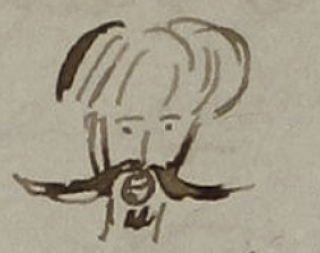
Among James Fitzjames's many gifts and proclivities, a weakness for what in Britain are called "puns," and in America "bad jokes" is among the most notable. And, in the world of such puns, the star of them all -- illustrated with a characteristic doodle (at left), goes thusly:

Q: "Why is Prince Albert’s kiss like this ship?"

A: "‘Cause its a hairy bus!"

Aside from the execrable homophony of the pun, it's curious that Fitzjames settled upon Prince Albert as its embodiment; in an age of famous whiskers, the Prince's were relatively moderate. Apparently, though, the jest hit home; in her copies of Fitzjames's correspondence with John Barrow Jr., Lady Franklin made her own copy of the cartoon!

His weakness for such puns is exemplified in many passages in his letters from HMS Erebus, mixed in with his jocular observations about others, as in this interchange with Osmer:

Osmar has just come from on deck (midnight) and is dancing with an imaginary skipping-rope. I said to him “What a happy chap you are Osmar you are always in a good humour.” His answer is, ‘Well, sir, if I am not happy here, I d’ont know where else I could be.”  – This will show you that we are really like a man shaving: So-appy!

Of course, some of the best instances of Fitzjames's jovial spirit are already well known -- his verbal portraits of his fellow officers in the "bundle of yarns" he sent to his sister-in-law, Elizabeth Coningham. These, though all meant in a light-hearted way (and meant only for private eyes), did occasionally veer into more pointed observations, using language that was omitted from the printed versions. Collins, the Second Master, he described as 

... the very essence of good nature, and I may say good humour - but he is mad, I am sure - for he squints to himself with a painful expression of countenance when he is thinking - (or thinking of nothing) and I can get no work out of him, though ever so willing he may be - yet he is not a bore nor a nuisance - but a nonentity.

He added, though, that "we intend however to make something of him." Edward Couch got a similar mix of caricature and praise; Fitzjames calls him

a little bullet-headed - blackhaired - smooth-faced lump of inanity - good humored however in his own way - writes, reads, works, draws - all quietly - is never in the way of anybody - and always ready when wanted.

But doubtless the best among these portraits is his description of James Reid, complete with an imitation of his particular brogue:

The most original character of all— rough, intelligent, unpolished, with a broad North Country accent, but not vulgar - good humored & honest hearted is  Reid - a Greenland whaler - native of Aberdeen - who has commanded whaling vessels. & amuses us with his quaint remarks & descriptions of the ice - catching whales &c. - For instance - he just said to me, on my saying we should soon be off Cape Farewell at this rate, & asking if one might not generally expect a gale off it (Cape Farewell being the south Point of Greenland). “Ah! Now, Mister Gems, we’ll be having the weather fine Sir! Fine! - No ice at arl about it Sir, unless it be the bergs – arl the ice’ll be gone Sir only the bergs which I like to see. Let it come on to blow look out for a big’un. Get under his lee. and hold on to him fast Sir, fast. if he drifts – too near the land - why he grounds afore you do!” I think the idea of all the ice being gone except the icebergs, is rich beyond description.

Monday, January 10, 2022

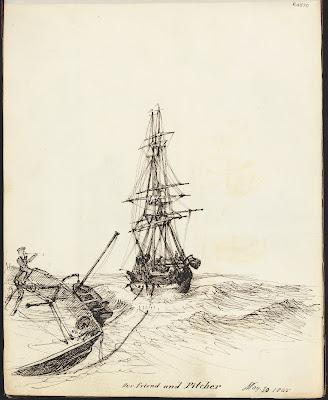
Our Friend and Pitcher

(National Library of Australia)
In the process of writing the notes for our volume of Franklin expedition letters, we learned a lot of seemingly random things: the name of a builder of cabinets for entomologists in St. Ives (John James Jarman), the fact that Franklin's friend Charles Beverly was then the head of the Bethlem Lunatic Asylum, and that a "treacle posset" might be good for you if you had a cold (recipe here). But among the more surprising discoveries began with the phrase "Our friend and Pitcher." Owen Stanley, a gifted draughtsman, was in command of HMS Blazer, one of two steam vessels (the other being HMS Rattler) that towed Erebus and Terror up the eastern coast of Britain to Stromness. Stanley made a number of sketches of the ships under tow, and gave one of them this title; in a letter, James Fitzjames mentions that "Stanley calls the Terror his friend and pitcher. This turned out not simply to be a pun (on account of the towed ships "pitching" about in the rough seas), but also a reference to a song, now lost in the mists of obscurity but then well-known enough that Fitzjames at once got the reference.

It was said to be George Washington's favorite play -- "The Poor Soldier" debuted in 1783, with music by William Shield and text by John O'Keefe. It was revived on numerous occasions, but by the 1840's one of its more popular songs had become a common feature of musical revues -- it was "My Friend and Pitcher":

My friend so rare, my girl so fair!
With such, what mortal can be richer?
Give me but these, a fig for care!
With my sweet girl, my friend and pitcher.

Of course, along with my fellow editors, I was enormously curious to hear this song -- but nary a recording of it seemed to exist. And then, to our great good fortune, we tracked down and got in touch with Dr. Sarah McCleave of Queen's University, Belfast. She had, we found, directed a student performance of "The Poor Soldier," and had recorded it on video. Making sure that she first obtained permission from the performers, she's generously agreed that we can share it here, so that everyone can hear the tune that was somewhere in the back of Stanley's and Fitzjames's mind -- so here it is! 

With our deepest thanks to Dr. McCleave, and to the performers: Laoise  Ní Cearnaigh (voice), Amy Wright (piano), and Vanessa Ní Gaoithín (violin). The complete lyrics can be found here.

Tuesday, November 30, 2021

May We Be Spared to Meet on Earth

At last it can be told: after more than five years of work collecting, transcribing, and annotating -- not to mention permission-getting, proofreading, and all the other thousand-and-one tasks that go into making a book, our volume of Franklin letters will be coming out in 2022!

One aspect of the challenge of this collection has been that there were many more letters than we'd originally thought -- when we started, we knew of only around 150 letters, but in the end we found nearly 200-- 195 to be exact. They include every known letter written by Franklin and his men from aboard ship, as well as letters written about the expedition during its planning stages. In addition to these letters -- 173 of them -- we have twenty-two additional letters written by friends and family members of the lost men during the early years of the search, in which hope still held that they might someday be delivered.

To give context to these letters, we've also prepared a series of chronologies, showing each stage in the preparations, and all the stops along the route the ships took on their way to Greenland; these are accompanied by detailed maps showing each stage of the voyage. In a series of Appendices, we offer other documents from the voyage, including a scientific report by Harry Goodsir, Franklin's official dispatches to the Admiralty, and three letters whose authors are unknown, as their only extant versions are from their appearance in newspapers. The book is also illustrated with drawings and charts made on board, ranging from the dramatic naval sketches of Owen Stanley, the playful doodles of James Fitzjames, and an engraved plate of natural history specimens based on sketches made on board by Goodsir. To top it all off, Sir Michael Palin (Erebus:The Story of a Ship) has contributed a Foreword!

So far as we are aware, the majority of these letters have never appeared in print before; those few that were printed during the living memory of the expedition were often redacted to remove personal information (these parts have been restored). Some others have appeared in books about the expedition, or biographies of its key figures, but others were unknown until quite recently. Among these are the letters of James Reid, Ice-Master aboard Erebus, which turned up in the State Library of New South Wales (his family members emigrated to Australia); Henry Le Vesconte (much of his family settled in Newfoundland, in whose archives his letters ended up), and Harry Goodsir, whose correspondence has been preserved in the archives of the Royal Scottish Geographical Society. Family members and descendants have also provided scarce letters, and we've also been the beneficiary of the family archive maintained by one of our editors, Mary Williamson, who is Sir John's great-great-grand-niece.

UPDATE: Originally slated to be released on July 15th, the book will now be available in the first week of September (dates may vary slight by country and vendor). As the publication date grows closer, we hope also to share news of book-related events, podcasts, and other social media happenings related to its release. It's an exciting time -- we can't wait to share our discoveries -- and give everyone some hints about what's to come!

Monday, September 27, 2021

Reginald the (un)Lucky

Levinge's grave on Ascension
Along with my colleagues Peter Carney, Gina Koellner, and Mary Williamson, I've found that the work on our forthcoming volume of letters of the Franklin expedition has produced all sorts of new insights into their undertaking. The earlier letters contain a good deal of discussion as to the selection of officers; while Sir John had the ultimate say-so, both Crozier and Fitzjames lobbied for several candidates, not all of whom ended up joining them.

One of the more interesting of these was Reginald Thomas John Levinge. We first hear of him in some of Crozier's letters to his friend James Clark Ross; he asks Ross to mention his name, and notes that his family is "among the oldest in County Meath." Levinge, in fact, was heir to a baronetcy, making him one of that class of Anglo-Irish gentry for whom Crozier's father, a solicitor, often worked. The Levinge Baronetcy had been created in 1704 for Richard Levinge, then Speaker of the Irish House of Commons; the family seat was Knockdrin Castle, an impressive Gothic pile commissioned by Richard Levinge, the 6th baronet, Reginald's father.

His older brother Richard began his career in the Army, while Reginald chose the Royal Navy; his date of entry was the 7th of January 1827, making him all of fourteen years old. The first step -- as was so often the case in an era of Naval downsizing -- was the longest; he didn't obtain his first commission until 1839. 1844 found him the senior lieutenant aboard HMS Volage, which post he still held at the time of Crozier's letter. Indeed, that service was probably the reason that Crozier was unable to reach him to make any offer; in the end, he accepted Franklin's recommendation of Edward Little. Although the prospect would certainly have been attractive to him, Levinge would seem to have dodged a bullet, at least for the moment.

In 1845, Levinge was appointed to his first command, that of HMS Dolphin, a small brigantine with only three guns. In November of that year, at the Battle of Parana off the coast of Argentina, he distinguished himself by remaining in the midst of the fray; as the Naval Biographical Dictionary describes it:
The little Dolphin on that day occupied a berth better suited to a frigate, and was so much exposed that the Commodore, the present Sir Charles Hotham, declared in his public despatch that he sometimes trembled when he beheld the shower of shot, shell, grape, and rockets flying over her. The gallantry of Mr. Levinge was in consequence rewarded with a Commander’s commission dated 18 Nov. 1845.
It was a glorious moment, to be sure. For, although the NBD next describes him as on half-pay as though retired, he evidently remained in service, where he encountered one more opponent more wily than the Argentinians: ship-board fever. The record is confusing, as no further command is listed in any source, but apparently he was aboard HMS Penelope when he succumbed on 24 April, 1848. Like many others in that situation, he was laid to rest on Ascension Island, in the Georgetown Cemetery.

As fate would have it, the very next day, those who would have been his colleagues and commanders stood at Victory Point on King William Island, where they removed a record left the year before, and made their poignant marginal addition:
H.M. ships 'Terror' and 'Erebus' were deserted on the 22nd April, 5 leagues N.N.W. of this, having been beset since 12th September, 1846. The officers and crews, consisting of 105 souls, under the command of Captain F.R.M. Crozier, landed here in lat. 69˚ 37' 42" N., long. 98˚ 41' W. Sir John Franklin died on the 11th June, 1847 ; and the total loss by deaths in the expedition has been to this date 9 officers and 15 men.
Levinge might well have been among these casualties, had he left to serve with Franklin -- and yet here he was, thousands of miles away, and death found him all the same. In a final irony, his grave at Ascension is just across the bay from "Comfort Cove" -- now known as Comfortless Cove -- a cemetery whose name appears in the notorious Peglar Papers, and may possibly have leant its name to a gathering of graves in the Arctic.

Monday, June 21, 2021

Found! John Gregory

After a considerable amount of diligent searching over several weeks, I'm very happy to be able to say that John Gregory's baptismal record -- as well as the marriage record of his parents -- have been found! The christening record was located first, with the assistance of Juliette Pochelu and Margaret Stanley. Margaret, in particular, did the valuable work of checking through all the records of 1805/1806 to be sure there were no other John Gregorys about. The result of this work was to identify a John Gregory born on 22 September 1806; his parents were listed William and Fanny (the latter a nickname for Frances). Everything matched, but there was one puzzle: the christening took place at St. Michael's, a "chapel of ease" (a place where more convenient church ceremonies could be held for those who lived at some distance from their parish church) -- and it was located in the district of Angel Meadows, the city's most notorious and squalid slum!

It was hard to imagine our John Gregory having grown up in such adverse circumstances, but the answer to the mystery was hinted at when Juliette sent me John Gregory's parents' marriage record; it turned out they had been married at Manchester Cathedral. Then, just recently, local family history expert Gay Oliver found records of William Gregory listed as a grocer on Chapel Street in Salford, a respectable middle-class trade in a respectable mercantile town. Since he signed his own name in the register, he was certainly literate, and doubtless his son learned to read and write as well.

Rev. Joshua Brookes
But why marry in the Cathedral and then have your firstborn baptized in a poorer neighborhood? The answer lies in Manchester's unusual ecclesiastical arrangement: while people could have baptisms at any church, weddings could only be held at the Cathedral -- specifically its Collegiate Church -- since it was the only official parish church of the entire city of Manchester and environs. The Wardens and Fellows of the Collegiate Church jealously guarded their sole right to conduct marriages, along with their fee of three shillings sixpence. This of course meant an extraordinary number of marriages, which were often conducted in "batches," often including as many as a dozen couples; William and Fanny were in a more modest batch of four. Presiding over all these ceremonies was the well-known divine Joshua "Jotty" Brookes, who had the duty from 1790 to his death in 1821; of him it was said that he conducted more marriages than any cleric in the history of England before or since!

All of which explains why William and Fanny were married at the Collegiate Church, but opted to have their son christened at a "chapel of ease," where the fees would be far more modest. Salford in their day was a growing, prosperous town -- it has since been entirely absorbed by the City of Manchester -- and Chapel Street was more or less its main thoroughfare. 

On a whim, recalling that my own ancestor -- James Clarke, my great-great-great-great-great-grandfather -- was born in Salford in 1804, two years before John Gregory -- I looked up his and his siblings' records. To my astonishment, I found that their address was also Chapel Street! It's a long street, of course, but it's wonderful to imagine my ancestor and John, only two years apart, passing each other on the pavement and perhaps knowing one another. James Clarke even had a sister, Frances, who was known as "Fanny," and also named after his mother -- and indeed we know that, John Gregory honored his mother's name by giving it to a daughter. And to add icing to the cake, James's parents were married in the same church as the Gregorys, and also by Brookes!

The Arctic shores of King William Island, where John Gregory's skull lay for more than a century and a half, are very far indeed from the streets of Salford -- but back in the early 1800's, my ancestor and he were almost neighbors. It certainly makes his death feel a bit more personal to me.

Sunday, May 23, 2021

Who was John Gregory (Part 2 of 2)


While we may never know exactly which of the several candidates for John Gregory's birth is the right one, there's a good deal more we can say about him. Perhaps most significantly, he has a listing in the Royal Navy's earliest volume recording the service of engineers; so far as I know, this entry hasn't been seen or cited by anyone researching his career.

Unfortunately, rather than recording his age, service, and character, the entry simply contains a statement, written across both pages of the ledger: ""This Engineer was recommended by Messrs. Maudslay to serve in the Vessels employed on the Arctic Expedition having been accustomed to locomotive engines his pay to be double of that allowed to 1st class Engineers (Woolwich 6th May 1845) ... Appointed 13th May 1845 Admiralty "Erebus" 1st acting ... Apptd. 1st Class Assistant 6 June 51." So we now know for a fact what we previously only inferred -- that he was recommended by his employers, Maudlay, Sons, and Field; we also know that he was specifically appointed with double wages. I checked the ledger, and a nearly identical statement is written in the record for James Thompson, who served as engineer aboard HMS Terror, but as with Gregory, there are no personal details.

Yet we do know one other thing about John Gregory, thanks to the envelope containing his lone surviving letter: we know his address was 7 Ely Place, St. George's Road. The location is a fascinating one; scarely a stone's throw to the east of the old Bethlehem Lunatic Asylum (now, perhaps fittingly, the Imperial War Museum), it also had an interesting neighbor for the first few decades of the nineteenth century: a large cylindrical shed used by Henry Aston Barker and his successors to paint new paintings for the Panorama in Leicester Square -- among them depictions of three Arctic expeditions: Franklin and Buchan in 1818, James Ross and James Clark Ross discovery of "Boothia" (1829-33), and James Clark Ross's search for Franklin (1848-49) -- it's the circular structure just to the southwest of Ely Place. This map, made circa 1800, shows that there was, originally, a row of small flats along the eastern side of Ely Place at the time. They seem likely to have been modest, townhouse-style flats; it would have been solidly respectable --- though somewhat cramped -- housing for John's wife Hannah and their six children. It was also within walking distance of John's employers.

These humble homes, alas, didn't stand for long; in the 1880's they were replaced by the West Square School for Boys, Girls, and Infants; its building still stands and is presently the Charlotte Sharman Elementary School. The building reduced Ely Place to more of an alleyway than a street; in 1934, after the land and buildings of the nearby asylum were purchased by Viscount Rothermere (then owner of the Daily Mail), the land on the opposite side of Ely Place was turned into a park named after his mother, Geraldine Mary Harmsworth. At around this time, it seems, the name of the street was changed to match, becoming Geraldine Street -- a name which the UK gazetteer tells me is unique in Britain. This image from Google Earth shows the view looking down Geraldine Street; the school building is on the left and the park is on the other side of the brick wall on the right.

I've already mentioned that John and Hannah's children were accomplished people -- several generations of them worked as engineers, with the exception of grandson Edward John Gregory, who became a noted painter. As to Hannah herself, she seems to have remained in the neighborhood, if not at the same address; in the 1870 census she appears to be living with her in-laws on South Street (modern Greenwich South Street) in Lambeth, but at her her death in 1873 she was apparently resident in the parish of St. Saviour's Southwark, a bit further north and closer to the river. I still hope to locate her grave, and will update this post if I do!

Saturday, May 22, 2021

Who was John Gregory? (Part 1 of 2)

As the news spreads around the world that John Gregory of HMS Erebus has become the first member of the Franklin expedition whose remains have been identified using DNA, many personal details about him have emerged. One them, or so it seems, was the fact that he married Hannah Wilson on the 14th of  April, 1823 at St. Michael's church in Ashton-under-Lyne, part of Manchester. And yet, the original record, now presented here thanks to parish sleuth Margaret Stanley, raises questions. For one, Hannah's name was originally recorded as "Ann," though in the top of the entry this has ben corrected. Second and more puzzling is the fact that neither John nor Hannah signed their name, instead making only a "mark" -- an "x" -- which generally in this context means the named person was illiterate. And yet, as we know from John's letter to Hannah sent back from the ships, he was at that time a literate man, one in fact with particularly neat and fine handwriting, a man who used words such as "circumference" and "jocosely." I find it nearly impossible to imagine that he was illiterate in 1823.

There are other possible reasons for the "x," however. Sometimes, if the minister simply assumed that the parties weren't literate, he may have instructed the bride and groom to simply "make a mark." Gregory, after all, was still a teenager, and since his and Hannah's first child was born a mere two months later, the circumstances of their appearance before the Curate may have not been particularly comfortable. Indeed, our best evidence that this John Gregory is the right one comes from the ages and dates of this children. As compiled by Juliette Pochelu (based on Margaret Stanley's researches), they were:

1. Edward, baptised June 15th 1823. Family resident in 'Town' 
2. Emanuel, baptised on August 21th 1825. Resident Stalybridge.
3. Frances, baptised June 17th 1827. Resident Stalybridge.
4. James, baptised on Decemer 20th 1829. Resident Stalybridge.
5. Rebecca, baptised September 23rd 1832. Resident : Town - so back in Ashton.
6. William, baptised October 12th 1834. Resident Manchester.
7. Eliza, baptised on July 9th 1837
8. John Jr., said to be 7 months old in the census, and the only one born at that address.

A ninth child, Frederick, was born on December 7, 1844 and baptized the following January; by the that time the family were living at Ely Place -- he was doubtless the baby John asked his wife to kiss! From the 1841 census, we can see that not all of these children were still living: Edward (18, though the census rounds this down to 15), Frances (13), James (11), William (6), and Eliza (4); Emmanuel and Rebecca died in childhood; the future fate of John Jr. is less certain.

We get a lively picture of this growing family, but some questions still remain. In the 1841 census, Hannah (once again, as she was in the marriage register, mis-recorded as Anna) is listed as 40 years of age and John as 35. Apparently, it was the practice of census takers then to round down to the nearest 5-year interval, which would explain Hannah being listed as 40 when she was probably 41. John, for the same reason, could have been any age shy of 40 and been listed as 35. We have her christening record from 1801, but with John, his name being far more common, we have a crowd of candidates. The most likely seems to be a man born in 1805 and christened at St. Michaels (not the later parish church of St. Michael and All Angels, but a small "chapel of ease" in Manchester); his parents were Ralph and Elizabeth.  According to research by Michael King Macdona, both Ralph and Elizabeth signed their names. There is also a candidate from 1798; his parents were Mary and Joseph, and his father's profession was given as "cordwainer" (shoemaker). 

And there are others: the noted historian of the non-officer classes of Franklin's men, Ralph Lloyd-Jones, has located a candidate born in 1790, although Stenton et., al. say they have a record of the death of that same person from 1791. Mr. Macdona has also located a candidate born in Eccles (on the other side of Manchester), baptized in January of 1802. In order, these candidates would give John Gregory an age in 1841 of 51, 43, 40, or 36; only the last of these matches the census record (and census records could be wrong, of course). 

By any measure, Mr. Gregory, who would have been at least 40 when the ships sailed, was among the older members of the expedition; Franklin was 59, and Crozier (the next oldest) 48; Osmer the Purser was 46; Thomas Blanky and James Reid, the Ice Masters were 45 and 44 respectively. One would think that, having already had a career as an engineer and a family, John Gregory would have left behind some more definite trace -- and in my next installment, I've more to tell! Certainly, though, he was well-remembered by his family, so much so that when his grandson, the artist and Royal Academician Edward John Gregory died in 1909, his grandfather's service in the Franklin expedition nearly as much space as the deceased himself!

UPDATE 5/24/21: Juliette has located a likely grave for the Eccles candidate, who I think we can now eliminate.

Wednesday, May 5, 2021

The backstory of John Gregory's Skull

The news came this week that one of the skulls found at the site of the Schwatka reburial at Erebus Bay on King William Island has been identified using DNA as that of John Gregory, who served aboard HMS Erebus as an engineer; the story has reverberated around the world, and rightly so. His are the very first human remains to be identified using DNA by a team led by Dr. Doug Stenton, which has been able to extract DNA from dozens of bones in their work over the past decade, but had never found a match -- until now.

And yet one thing that hasn't been widely reported is that this skull, catalogued as "cranium #80," was actually not discovered recently -- indeed, though it wasn't brought back from stony shores of Erebus Bay until 2013,  it had first been spotted by Barry Ranford twenty years earlier. It's the same skull that he showed to the CBC's Carol Off when she was there for a short television documentary in 1995 (you can watch her original story here)

How can I be so sure? Well, Andrew Gregg, who was the cameraman on that occasion, also took a number of still photos, including this one:

Photograph © 1994 Andrew Gregg

As one can see, this skull -- when rotated to an upright position as I've done in the first image above, is an exact match for Keenleyside, Stenton, and Park's "cranium #80," the same now known to be Gregory's. The indentations associated with the missing teeth are identical, and so is the shape of the distinctive injury to the right maxilla. You can even see the small circular dot or indentation just above where the nasal bones meet the frontal bone.

The other skull, the one atop the reburial, had grown quite mossy, as can be seen in another of Gregg's photos, quite a different situation from its bleach-white brother:

© 1994 Andrew Gregg

In 1997, the two crania on the surface, along with a nearby femur, were placed in a metal box for protection and cached on the site in a new cairn, by Ranford's friend John Harrington. Ranford himself had committed suicide the previous autumn, but Harrington was to return on at least six more occasions, continuing the search for Franklin remains that his late colleague had begun. A few years ago, John and I attended a lecture by Diana Trepkov, who did facial reconstructions of this and the other skulls found nearby. "Let's go have a look at an old friend," I'd suggested to him.

Back in 1993, when Ranford first came upon the skull, he was nearing the end of a long trek down the western coast of King William Island. His travelling companion had become so sick that he'd had to haul him along in the wheeled garden cart they'd brought for supplies, and time was growing short. At first, he'd thought it was a plastic bleach bottle, it was so white, but on coming closer he realized his error. It was to be a fateful discovery.

Sunday, March 28, 2021

John Torrington, Intriguing Person

I'd heard about it for years, how John Torrington -- the unfortunate leading stoker on HMS "Erebus" -- had found himself in the pages of People® Magazine. What I hadn't realized what that he'd been chosen -- along with Bill Murray, Michael Jackson, and Vanessa Williams as one of the "Most Intriguing People of 1984." With a little bit of rummaging around on eBay, it wasn't too hard to get a copy of the original magazine, and have a look at Torrington's pop-cultural debut

The accompanying article, written by Jack Friedman, gives us a fascinating snapshot in time -- not just at Torrington, but at Owen Beattie's perspective on his work. It's not often recalled, but in the 1984 field season, permits came so late that Beattie only had time to exhume one of the three Franklin expedition members buried on Beechey Island, and -- perhaps because his was nearest the shore -- he picked Torrington. So his remarks, as quoted by Friedman, predate the exhumation of Hartnell and Braine, and the later book written in collaboration with John Geiger. 

Interestingly, Beattie characterizes the Franklin expedition as "successful in an unsuccessful way," saying that he believed that they had achieved their goal of the Northwest Passage (this must be based, I'd assume, on the presence of expedition remains near Cape Herschel, a point previously surveyed from the west by Dease and Simpson). Beattie calls his team "simply and extension" of the earlier searches, from the late 1840's to the present day. In response to what must have been a question about how respectful it was to dig up such a long-frozen man, Beattie declared "I work with the bones of dead people all the time. I'm sensitive to the fact that they were people. None of us felt we were violating a privacy."

The condition of Torrington's lungs had already led them to the conclusion that his most proximate cause of death was pneumonia. And yet, according to Beattie, they were still waiting for full lab results: "In the coming months," Beattie said, "we'll be analyzing hair and nail samples to see if other health problems can be identified." Lead, however, had apparently already been detected, and the hypothesis that it came from the food tins is mentioned. The article says that "this may help explain some of the seemingly irrational decisions made by Franklin and his men."

There's one other fascinating detail: 

"Before the coffin was re-sealed, the scientists at the grave site placed a note in it that was written by a woman on Beattie's team, Geraldine Ruszala, and signed by all of them. 'We had some serious thoughts,' says Beattie. 'I don't want to get too schmaltzy about it. It's simply a private note about our feelings as human beings.'"

Torrington's grave has been undisturbed since, but his presence -- as conveyed by Beattie's work and the photographs taken at the time -- lingers on. He's been the inspiration for a number of songs, most notably James Taylor's "The Frozen Man," along with Iron Maiden's "Stranger in a Strange Land," not to mention a range of poems and novels, including Mordecai Richler's wry Solomon Gursky Was Here. His was, as James Dzieszynski has remarked, an "unintentional journal to immortality" -- no one would be more surprised than he to know how long his story has persisted.

NB: You can download a .pdf of the entire article here.

Wednesday, March 3, 2021

"The Terror" comes to the BBC

Jared Harris as Captain Francis Crozier
Back in March of 2018, when viewers in North America turned on their televisions to see what "The Terror" was all about, there was a lot of explaining to do. Not so much in Canada, where Sir John Franklin has remained a cultural touchstone, but certainly in the United States, where "Franklin" usually means "Benjamin." And now, three years later, Franklin and his officers and crew are, as it were, returning home thanks to the BBC. Franklin may need a little dusting off even there, though the ground has been admirably prepared by Michael Palin's wonderful book Erebus: The Story of a Ship, but in chatting with Paul Franks on BBC radio's West Midlands service yesterday, I still needed to go over the basics -- what was the Northwest Passage, why was it do damned important, and who was this Franklin chap anyway?

As they say, it's a long story. But the basics are simple: the Northwest Passage, originally envisioned as the "sea route to the Orient," was by the mid-nineteenth century a more abstract prize: numerous expeditions had been launched and failed, enough for Arctic veteran Sir John Ross to declare to a Parliamentary Committee that, even if found, the Passage would be "utterly useless" for commercial ships. Still, for a maritime nation, the lack of having managed it was a perceptible failing, one which Franklin's expedition was widely expected to resolve. Under the command of Franklin -- who had mapped much of the mid-section of the Passage already --  with two ice-strengthened ships, the "Erebus" and "Terror," fresh from a successful Antarctic voyage, the expedition seemed destined to succeed. Until it disappeared with scarcely a trace, defeating every effort to find more than a skeleton or a scrap of paper for decades, even as disturbing accounts, collected from the native Inuit people, told of starvation, cannibalism, and exhausted men who "fell down as they walked."

Like the novel by Dan Simmons on which it's based, the show builds a tissue of horrific fiction around this armature of historical fact. For those of us who already find the factual story endlessly fascinating, a certain additional suspension of disbelief will be required. We'll have to let go of our idealized version, for instance, of Franklin, and let Hinds's masterful performance of Sir John as an ambitious commander who throws caution to the winds, take its place; our Fitzjames will, as Menzies portrays him, be less whimsical than the lively young fellow evident in his letters home; our Crozier, above all, will be darker: feeling that his sense of the perils of the ice is not being taken seriously, he turns to drink and grim warnings: "Our situation is more dire than you may understand." Jared Harris's performance is the highlight of the series for me; no other actor I know so perfectly combines -- and balances -- darkness and light. All these new characters, though drawn differently from the way we've seen them before, serve this show's narrative as faithfully as the original officers served their nation's Navy.

I won't be giving any spoilers here -- though the curious can read the episode-by-episode recap and commentary I wrote for Canadian Geographic on their website -- but I will say that, despite the fact that its horror is of a different and more fantastical kind, the show captures the bleak realism of Franklin's ill-fortune with remarkable clarity. Part of this is thanks to an excellent production crew and visual effects team, who worked magic with the look and feel of the ice, as well as having the expert advice of ship-modeler extraordinaire Matthew Betts which has made the structure and shape of both ships remarkably accurate, far more so than your usual "Master and Commander" fare. And these three actors, along with a brilliant supporting cast, well portray the essential human drama at the core of it all -- it's not "man vs. ice" but "man vs. man vs. himself vs. ice" -- a far more psychologically vexed formula, even before we meet the horror that awaits.

Thursday, December 17, 2020

The Goodsir Brooch

It may be one of the most extraordinary relics of the Franklin expedition that's never before been seen: a brooch, containing in its inmost oval a weave of human hair, including that of Henry Duncan Spens Goodsir.

But Harry's hair is not alone; ten other individuals from the Goodsir and Taylor families are represented, the eldest being the Reverend Joseph Taylor (1742-1815), and including both of Harry's parents, his brother Archie and his sister Agnes (both of whom died young, Archie at 23 and Agnes at the tender age of one. The choice of the Goodsir siblings suggests to me that the original impulse of the brooch's being made was memorial, which the black border seems to also indicate. The most likely occasion would seem to be on or after the death of the Reverend Anstruther Taylor in 1863; his name is engraved on the back. Presumably, some locks of hair had been preserved by the families from the others; such brooches were not uncommon (see this example from the Victoria & Albert Museum), though the large number of individuals represented -- confirmed in a handwritten list kept with the brooch -- is certainly unusual.

The brooch was kept in the family, passing from Jane Ross Goodsir (who probably commissioned it) to her cousin Dr. Harry Goodsir Mackid (1858-1916) in Canada (he was the son of Harry's aunt Jean Forbes (Taylor) Mackid). From him, it passed through the generations, ending up in the care of his great-grandson Court Mackid. When Michael Tracy tracked him  down, Court shared images and information about it, and both realized its enormous historical significance. One thought, of course, was to have it tested for DNA, but the difficulty of analyzing rootless hairs -- though one technique now seems capable of managing this -- combined with that of isolating one individual's sequence from among 11 -- made such a prospect daunting. Neither Court nor Michael wished to damage the brooch or its contents, and the only available method of DNA analysis would have destroyed the hair used in it.

So the two cousins decided upon a different course -- they would jointly donate it to the Museum of the Royal College of Surgeons in Edinburgh; the Museum was pleased to accept it, and -- once these current days of pandemic-reduced services are past -- there it will be preserved, in the very halls where Harry once served as conservator.